What is encoded in a marmoset phee call? Food context beyond arousal and valence

What is encoded in a marmoset phee call? Food context beyond arousal and valence
Briefer, E. F.; Wierucka, K.; Ermatinger, F.; Bruegger, R. K.; Ciccarelli, E.; Meshinska, K.; Ernst, K. S.; Burkart, J. M.
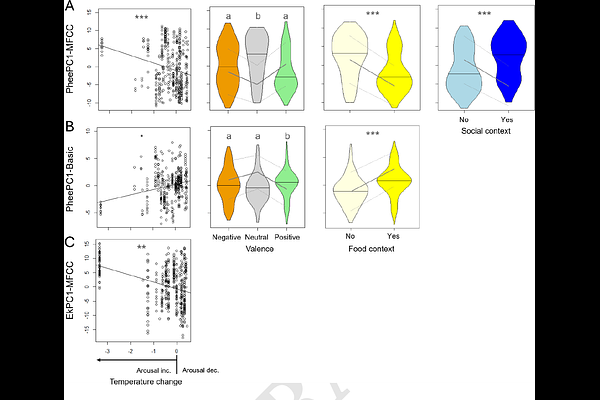
AbstractAnimal vocalisations can convey information about external events, but whether this goes beyond reflecting the emotional state elicited by these events is debated. To explore this, we studied the acoustic structure of common marmoset (Callithrix jacchus) phee (long-distance contact) and ek (alert/mobbing) calls produced in five treatments varying in the emotional valence and arousal they elicit (internal state), as well as food and social context (external events). We measured changes in arousal via nasal temperature and analysed both basic acoustic parameters and Mel-frequency cepstral coefficients (MFCCs) of the calls. Support Vector Machines combined with Linear Mixed effect models revealed that phee calls encode both external events and internal states, while eks reflected predominantly arousal. Notably, an acoustic signature related to food context was present in phees both when provided (positive valence) and teased with highly preferred food items (negative valence), and even when food was not physically present (food call playback treatment). This suggests marmoset long-distant phee calls encode external information beyond emotional arousal and valence, and independently of the presence of an immediately triggering stimulus.