Computational Design for Engineering Layered Tissue Architectures via Cell-Cell Interfacial Tension Modulation

Computational Design for Engineering Layered Tissue Architectures via Cell-Cell Interfacial Tension Modulation
Thiticharoentam, C.; Fukamachi, S.; Horiguchi, S. A.; Okuda, S.
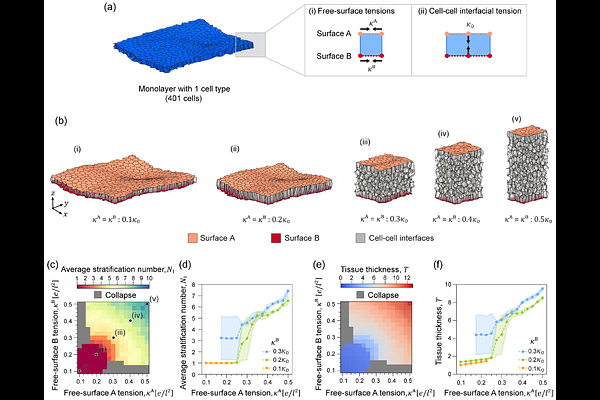
AbstractThe spatial arrangement of cells is fundamental to the mechanical and functional integrity of three-dimensional (3D) tissues, yet engineering spatially well-controlled tissue architectures remains challenging. Here, we computationally investigated how layered tissue architectures can be designed by modulating cell-cell interfacial tension. We performed simulations using a 3D vertex model and systematically varied interfacial tension magnitudes. The simulations generated a range of layered tissue architectures, including planar monolayers, bilayers, and structurally stratified states. In homogeneous cell populations, increasing interfacial tension drove transitions from monolayer to structurally stratified configurations. In heterogeneous populations, differential interfacial tensions induced out-of-plane cell sorting and the formation of compositionally sorted multilayers. Moreover, a recursive tension design strategy enabled hierarchical organization of multiple cell types into separate layers. Notably, this recursive scheme uses only two tension levels (high vs. low) assigned across interfaces and can, in principle, be extended to specify layered architectures with an arbitrary number of layers. Together, these results identify cell-cell interfacial tension as a tunable mechanical parameter for regulating layered tissue architecture and provide design principles for layered tissue engineering and regenerative medicine.