B-Fields and Star Formation across Scales with TRAO (B-FROST): CO Abundances, Dynamics and Relative Orientations in the Translucent High Latitude Cloud MBM12

B-Fields and Star Formation across Scales with TRAO (B-FROST): CO Abundances, Dynamics and Relative Orientations in the Translucent High Latitude Cloud MBM12
J. M. Vorster, J. Montillaud, M. Juvela, E. Falgarone, J. Oers, E. Mannfors, D. Alina, Q. Gu, H. Kang, C. W. Lee, S. Li, T. Liu, K. Pattle, V. -M. Pelkonen, I. Ristorcelli, A. Zavagno, L. V. Tóth
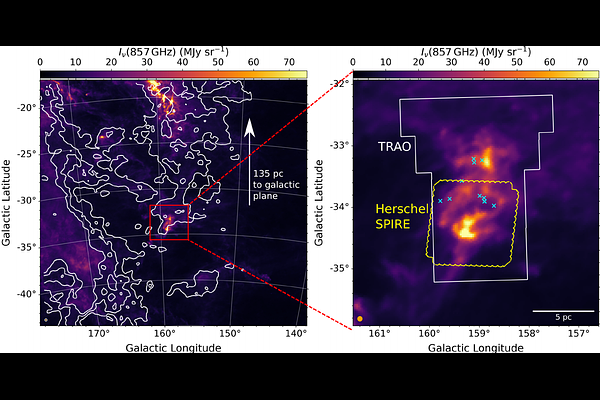
AbstractIn our Galaxy, the average star formation efficiency is of the order of a few percent. We investigated the high-latitude molecular cloud MBM12 as part of the B-fields and star formation across scales (B-FROST) survey with the Taeduk Radio Astronomical Observatory (TRAO) to assess why star formation activity in MBM12 is low. We combine {\it Herschel}-based, locally $κ_ν$-calibrated $N$(H$_2$) estimates with $^{12}$CO and $^{13}$CO ($J=1-0$) observations (2.5$^\circ \times$3$^\circ$ at 48$''$) to map $N$(CO), $X$(CO), and [CO/H$_2$], compute multi-scale $α_{\rm vir}$ and mass-size scaling laws from dendrograms, and derive the histogram of relative orientations from {\it Planck} dust polarisation. We identify four main regions based on velocities that have H$_2$ column densities ranging from $2\times10^{20}$ cm$^{-2} - 1.3\times10^{22}$ cm$^{-2}$. The average $X$(CO) is close to the galactic average, with variations below $X_{\rm Gal}$ from collisional de-excitation in low-density gas, and above $X_{\rm Gal}$ from CO photodissociation at cloud edges. The hierarchical structures follow a broken power law mass-size relation $M=AR^α$. The values of $α_{\rm vir}$ ranged from $3-60$, with the smallest values at 0.1 pc scales. The mass-size relations for the structures with the lowest $α_{\rm vir}$ have scaling factors $A$ three times larger than those of high $α_{\rm vir}$ structures, indicating external pressure one order of magnitude larger. We found a transition of parallel to perpendicular between column density structures and magnetic field orientations at $N$(H$_2$) $= 4.5 \times 10^{21}$ cm$^{-2}$. We provide the first integrated chemical, dynamical, and magnetic field analysis of MBM12. Scale-dependent mass-size and virial analysis can further constrain the role of external pressure in regulating the star formation efficiency.