Revisiting the Perseus Cluster II: Metallicity-Dependence of Massive Stars and Chemical Enrichment History

Revisiting the Perseus Cluster II: Metallicity-Dependence of Massive Stars and Chemical Enrichment History
Shing-Chi Leung, Seth Walther, Henry Yerdon, Ken'ichi Nomoto, Aurora Simionescu
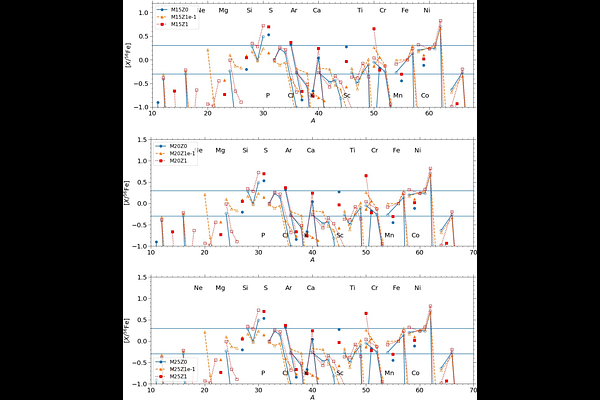
AbstractThe legacy Hitomi telescope has delivered the precise measurements of the chemical abundances in the Perseus Cluster, covering the Si-group (Si, S, Ar, Ca) and Fe-group elements (Cr, Mn, Ni). In Paper I (Leung et al., ApJ 2025), we examined the role of convection parameters and presented new core-collapse supernova (CCSN) explosion models at solar metallicity, which fit the observed abundance pattern. In this article, we extend our calculation for the stellar evolutionary models and CCSN models of the initial mass $15 - 60M_{\odot}$ and the metallicity $Z = 0 - Z_{\odot}$. The detailed pre- and post-explosion chemical profiles are calculated with a large post-processing network to capture the production of $α$-chain elements (e.g., Si, S, Ar), odd-number elements (e.g., P, K, Cl), and iron-group elements (e.g., Mn, Ni). We study the role of CCSNe in the production of these elements. We compare the galactic chemical evolution model based on the nucleosynthesis yield of the new massive stars and other yield tables from the literature. For each supernova yield, we perform parameter surveys and search for configurations that produce the best-fit model and best-rate model using the Perseus Cluster as the reference. From the survey, we study how individual chemical elements affect the contributions of massive stars and Type Ia supernovae in the cosmic chemical enrichment