Age-dependent effects of infection on survival of a wild rodent reservoir host

Age-dependent effects of infection on survival of a wild rodent reservoir host
Wearing, K. E.; Veitch, J. S. M.; Mistrick, J.; Harp, D. F.; Haile, B. B.; Fragel, C. G.; Sironen, T.; Craft, M. E.; Cressler, C. E.; Hall, R. J.; Budischak, S. A.; Forbes, K. M.
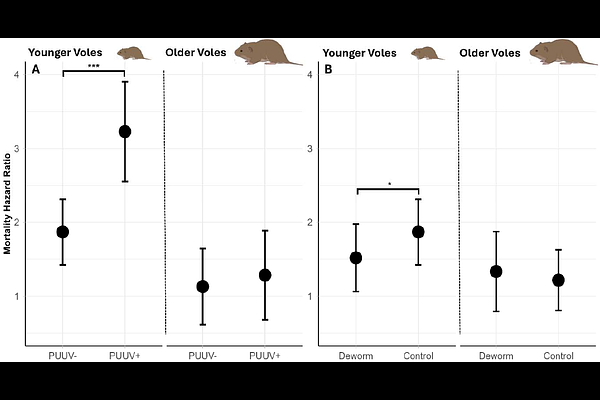
AbstractDue to long co-evolutionary histories, many zoonotic pathogens are thought to exert little or no negative effects on their wildlife reservoir hosts. However, there remains a lack of rigorous investigations in natural settings. We conducted a 3-year factorial field experiment to investigate how survival of the Puumala hantavirus (PUUV) reservoir, the bank vole, is impacted by PUUV infection, nematode infections, and food availability. We hypothesized that PUUV would not impact survival, but that coinfection with nematodes would negatively impact survival, and that increased food availability would mitigate the negative effects of coinfection. Surprisingly, we demonstrated that PUUV infected voles had substantially reduced survival when compared to uninfected voles, and this strong negative effect manifested in young voles. Nematode removal increased survival of young voles and food supplementation interacted with movement rather than survival. Our results provide empirical evidence in a natural system for infection reducing survival of its reservoir host.