Up, Up, and Away? Quantifying ISM Fallback using Ram Pressure Stripping Simulations

Up, Up, and Away? Quantifying ISM Fallback using Ram Pressure Stripping Simulations
Harrison J. Souchereau, Stephanie Tonnesen, Jingyao Zhu, Jeffrey D. P. Kenney
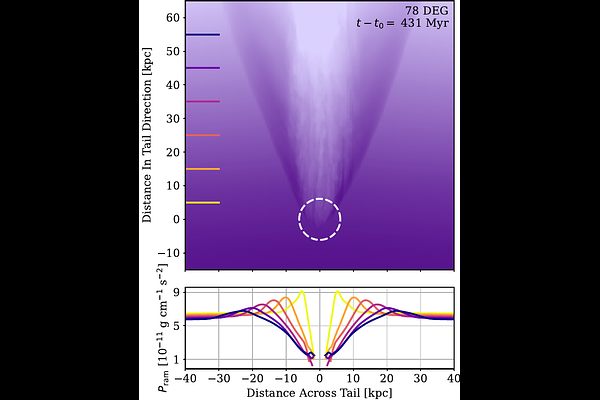
AbstractThe evolution of the cold interstellar medium (ISM) in satellite galaxies orbiting through mass hosts is an important factor in how they evolve while experiencing ram pressure stripping (RPS), as cold molecular gas clouds are the most difficult ISM component to fully strip and serve as the sites of star formation. We investigate ISM evolution using a suite of hydrodynamical wind tunnel simulations with an intermediate mass ($M_* = 10^{9.7}$ M$_\odot$) galaxy orbiting in a Coma cluster-like environment, varying the disk-wind angle. Even if the ultimate fate of a ram pressure stripped galaxy is complete gas removal, we find that cold gas evolves through cycles of outflow and inflow (fallback). We show that fallback can be identified at a wide range of wind angles, but is elevated for angles closer to edge-on and occurs predominantly in a specific quadrant (trailing side, rotating into the wind). Most inflow occurs in gas that never leaves an ``inner tail" region that extends to $\sim20$ kpc. We discuss possible reasons for when and why fallback occurs using simple idealized simulations. For a highly inclined disk, offset rotational motion is a major driver of fallback, while disk shadowing and cloud growth can act at all wind angles. Lastly, we discuss the relative importance of each mechanism at different stages of a galaxy's evolution under ram pressure, and compare our findings with instances of ISM fallback detected in observed RPS galaxies.