Body size, dental pathology and maternal genetic diversity of ancient horses in the eastern Baltic Sea region and western Russia

Body size, dental pathology and maternal genetic diversity of ancient horses in the eastern Baltic Sea region and western Russia
Honka, J.; Salazar, D.; Askeyev, A. O.; Askeyev, I. V.; Askeyev, O. V.; Aspi, J.; Asylgaraeva, G. S.; Niskanen, M.; Mannermaa, K.; Olli, S.; Piipponen, N.; Piliciauskiene, G.; Shaymuratova, D. N.; Valiev, R. R.; Kvist, L.
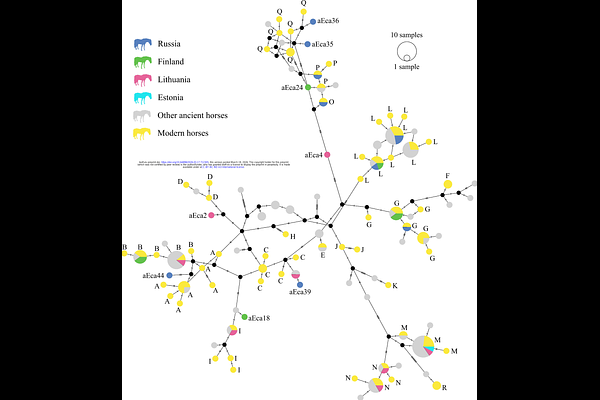
AbstractThe early evolutionary history of modern domestic horses (Equus caballus/E. ferus caballus), known as the DOM2 lineage, is well documented due to numerous archaeological and ancient DNA (aDNA) studies. Although many uncertainties remain in the domestication timeline, current evidence suggests that the domestication of modern horses began in the Pontic-Caspian steppe at least ~2700 BCE (before common era), or even earlier. However, it is not known how long remnant wild horse populations survived or when domestic horses were introduced into Northern Europe. In this study, we review the current knowledge of horse domestication, focusing on Northern Europe. We analysed prehistoric horses from western Russia to assess the body sizes of wild horses from the Ivanovskaya site (5900-3800 BCE) in the Pontic-Caspian steppe, and the body weight of one Lithuanian wild horse (4000-3800 BCE). Additionally, we analysed body sizes of Late Bronze Age-Early Roman Age horses (1100 BCE-300 CE; common era) and re-analysed body sizes and estimated rider weights of historic domestic horses from Lithuania (100-1400 CE). We searched for pathological changes and signs of bit wear indicative of bridling. Furthermore, we investigated maternal genetic diversity by sequencing ancient mitochondrial DNA. We found that wild horses from Ivanovskaya were intermediate in body size between earlier and more recent horses of the Eurasian Steppe, and that the Lithuanian wild horse weighed only ~270 kg and Late Bronze Age-Early Roman Age horses 200-300 kg. Lithuanian domestic horses were pony-sized (< 130 cm on average). Bit wear was confirmed on one tooth, the oldest domestic horse in Lithuania (799-570 cal BCE). Another tooth showed signs of the Equine Odontoclastic Tooth Resorption and Hypercementosis (EOTRH) condition. Mitochondrial DNA was successfully amplified from one Ivanovskaya wild horse along with 25 other ancient samples, including Lithuania's oldest domestic horse. mtDNA diversity was high, revealing several maternal lineages.