The impact of cosmic filaments on starburst galaxies across cosmic times

The impact of cosmic filaments on starburst galaxies across cosmic times
Baptiste Jego, Matthieu Béthermin, Katarina Kraljic, Clotilde Laigle, Lingyu Wang, Antonio La Marca, Olivier Ilbert, Hollis B. Akins, Caitlin M. Casey, Gavin Leroy, Ali Hadi, Jeyhan S. Kartaltepe, Anton M. Koekemoer, Henry Joy McCracken, Louise Paquereau, Jason Rhodes, Brant E. Robertson, Marko Shuntov, Greta Toni, Can Xu
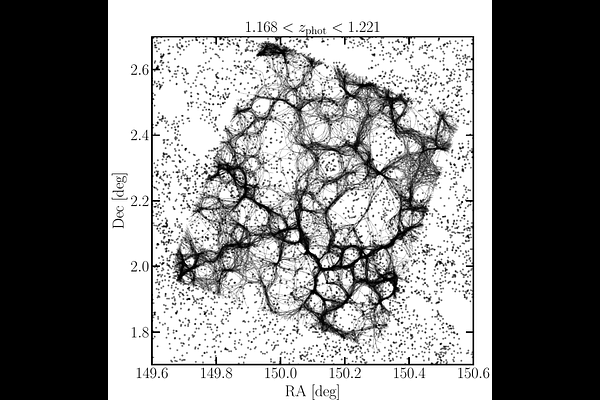
AbstractCosmological simulations suggest that various galaxy properties depend on their location within the cosmic web. Yet direct observational evidence of the dependence of star formation activity on distance to filaments remains scarce and is missing at z>1. We investigate how starburst, main-sequence (MS), and quenched galaxies are distributed with respect to cosmic web filaments, and how this distribution evolves with redshift. We first use the SIMBA cosmological simulation to predict the redshift evolution of the mean distance to the closest filament from z=3 to z=0 for different galaxy populations after removing stellar-mass dependencies. We then measure the corresponding signal in the COSMOS field, using COSMOS2020 and COSMOS-Web data, where accurate photometric redshifts enable reconstruction of the projected cosmic web from z=2 to z=0.5, and starbursts are identified through far-infrared spectral energy distribution fitting. In agreement with the results from SIMBA, starburst galaxies are found closer to filaments at z>1 and at larger distances at z<1, MS galaxies occupy intermediate environments with little evolution, and quenched galaxies show progressively shorter distances to filaments toward low redshift, with a crossing between starburst and MS populations around z~1. In COSMOS-Web, the relative evolution in the average distance to filaments between starburst and MS galaxies is detected at a significance level of at least 5σ. We show that a minimal toy model in which the only environmental ingredient is the sSFR-filament distance modulation measured in simulations is sufficient to reproduce the observed differential evolution of the average filament distance between starburst and MS galaxies. These results show that the imprint of large-scale environmental effects on the star formation activity of galaxies, predicted by simulations, is detectable from z=2 down to z=0.5.