The dispersal of compact protoplanetary discs

The dispersal of compact protoplanetary discs
Giovanni Picogna, Barbara Ercolano
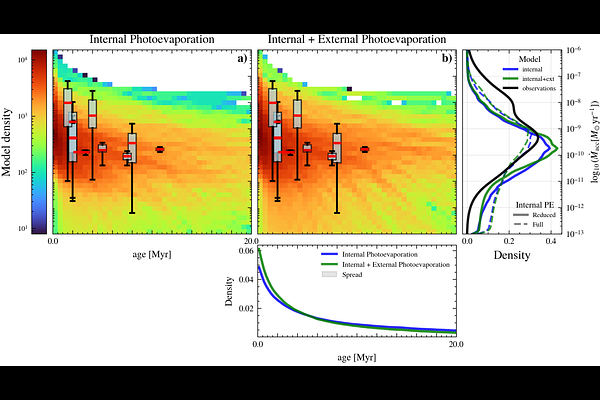
AbstractCompact protoplanetary discs are becoming increasingly prominent in observations. Their dispersal pathways may differ substantially from those of extended discs. We aim to quantify the role of the disc outer radius in internal photoevaporation, provide a simple scaling relation for compact discs, and test whether the resulting evolutionary tracks reproduce the observed inside-out clearing of young stellar populations. We performed radiation-hydrodynamic simulations of X-ray-driven photoevaporation for discs with different outer radii, and derived the dependence of the total mass-loss rate on the cut-off radius. We find that the surface mass-loss profiles are nearly independent of disc size, but their integrated wind rates are reduced according to the cumulative mass-loss rate distribution. We incorporated this scaling into disc population synthesis models. When the internal photoevaporation is applied only up to the cut-off radius compact discs evolve via inside-out clearing consistent with observational diagnostics, while when the cut-off radius is not considered, the disc spreading is hindered and the disc dispersal proceeds from the outside-in. The introduction of mild external photoevaporation present in nearby star forming regions cannot prevent the disc spreading when the cut-off radius prescription is included, but it can much better explain the evolution of disc radii as a function of time. Disc dispersal prescriptions must include the dependence on disc cut-off radius to capture the evolution of compact discs. The proposed scaling provides a simple, physically motivated correction that better predicts the growing observational evidence for compact discs and inside-out dispersal.