Exposure to (Z)-3-hexenol primes tobacco plants for faster and stronger defense without negatively affecting their ability to grow and reproduce

Exposure to (Z)-3-hexenol primes tobacco plants for faster and stronger defense without negatively affecting their ability to grow and reproduce
Paudel Timilsena, B.; Seidl-Adams, I.; Hind, S. R.; Tumlinson, J. H.
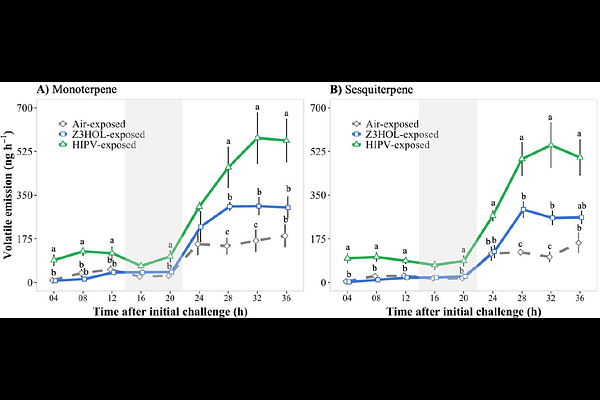
AbstractPlants exposed to volatile signals from herbivore-infested neighbors can activate faster and stronger defenses against subsequent herbivore attack, a phenomenon called defense priming. However, the specific volatile components responsible for activating defense priming remain unclear. Here, we examined the role of green leaf volatiles (GLV) by silencing their biosynthesis using the virus-induced gene silencing technique. Exposure to a full blend of herbivore-induced plant volatiles (HIPV) primed receiver plants for enhanced production of all 5 groups of HIPV (GLV, monoterpenes, sesquiterpenes, aldoximes, and indole). When GLV production was silenced in emitter plants, receiver plants were no longer primed for terpene production. However, exposure to (Z)-3-hexenol (Z3HOL) alone primed receiver plants for terpene production. These results suggest that GLV are necessary, and Z3HOL alone is sufficient, to prime terpene production in receiver plants. Consistent with enhanced resistance, Manduca sexta larvae feeding on Z3HOL- or HIPV-primed plants consumed less leaf tissue and exhibited reduced growth compared with controls. Importantly, priming did not impose fitness costs, as Z3HOL-exposed plants showed normal growth but produced more seed capsules and seeds than control plants. Together, these findings suggest that Z3HOL alone is sufficient to prime plants for better defense without compromising their ability to grow and reproduce.