A 3D physico-chemical model of a pre-stellar core. II. Dynamic chemical evolution in a pre-stellar core model using tracer particles

A 3D physico-chemical model of a pre-stellar core. II. Dynamic chemical evolution in a pre-stellar core model using tracer particles
S. S. Jensen, S. Spezzano, P. Caselli, T. Grassi, O. Sipilä, T. Haugbølle
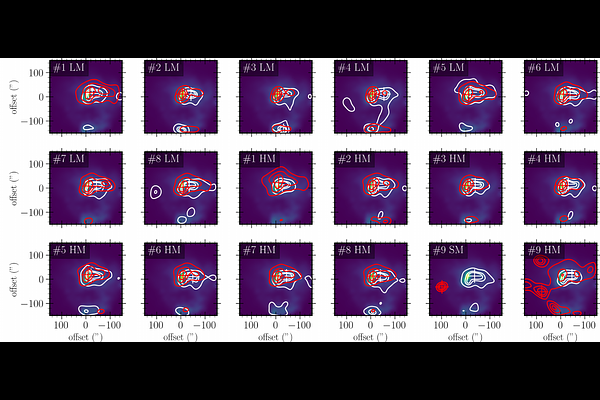
AbstractThis work explores the differences between static and dynamically evolving physico-chemical models of pre-stellar cores. A 3D MHD model of a pre-stellar core embedded in a dynamic star-forming cloud is post-processed using sequentially dust radiative transfer, a gas-grain chemical model, and a non-LTE line-radiative transfer model. The chemical evolution is modeled along $\sim$20,000 tracer particle trajectories to capture the impact of a realistic dynamical evolution as the core is formed. The emission morphology of CH$_3$OH and $c$-C$_3$H$_2$ and the intensities of CH$_3$OH, $c$-C$_3$H$_2$, CS, SO, HCN, HCO$^+$ and N$_2$H$^+$ are compared with observations of L1544. Our results show a distinct difference in chemical morphology between the dynamical and static models. The dynamical model reproduces the observed spatial distribution of CH$_3$OH and $c$-C$_3$H$_2$ toward L1544, whereas the static model fails to reproduce this morphology. In contrast, when comparing modeled and observed intensities across a broad range of molecules, the static model shows good agreement with observations for L1544. The dynamical model systematically predicts lower abundances and modeled intensities for six of the seven species presented here. For sulphur-bearing species, the intensities are in better agreement with observations when the initial abundances are undepleted in heavier elements. This study reveals distinct differences between dynamical and static physico-chemical models. The static model predicts higher abundances and intensities for the majority of the molecules studied here, compared with the dynamical model. This discrepancy may stem from the specific choices of initial conditions, which could limit the dynamical models ability to fully capture the physical and chemical history. The intensities predicted by the static model are comparable to those observed toward L1544.