A semi-analytic model of the bouncing barrier for protoplanetary dust aggregates

A semi-analytic model of the bouncing barrier for protoplanetary dust aggregates
Sota Arakawa, Haruto Oshiro, Yuki Yoshida, Kiwamu Yoshii
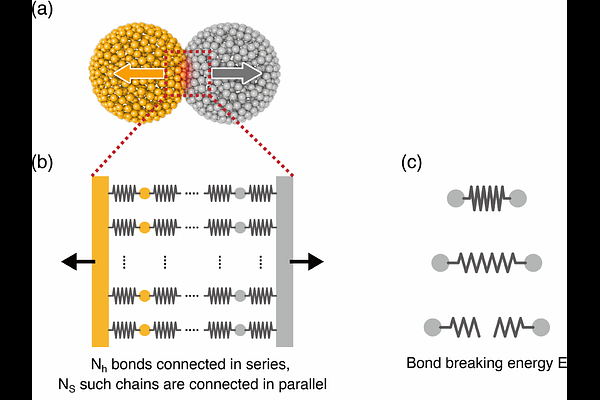
AbstractCollisional bouncing limits the growth of dust aggregates in protoplanetary disks, but its dependence on aggregate size, collision velocity, and filling factor remains poorly understood. Here we develop a semi-analytic model for the sticking probability of colliding dust aggregates. We divide each aggregate collision into two phases: a compression phase and a separation phase. The compression phase is described with an elastoplastic contact model, which determines the maximum contact radius and repulsive energy after compression. The separation phase is treated as fracture of a stochastic network of interparticle bonds, whose fracture energy is evaluated using weakest-link statistics. The model naturally predicts that larger aggregates bounce more readily because larger contact regions are more likely to contain weak bonds. Comparison with distinct element method simulations shows that the model reproduces the simulated sticking--bouncing boundary. Furthermore, applying the calibrated model to moderately porous aggregates inferred from ALMA observations of protoplanetary disks, we find that the predicted bouncing barrier passes through the observationally inferred size--velocity range. Thus, our semi-analytic model provides a useful framework for predicting the collisional evolution of protoplanetary dust aggregates.