Geometric obstruction to resolving the Hubble tension: orthogonality of scale and shape in distance measurements

Geometric obstruction to resolving the Hubble tension: orthogonality of scale and shape in distance measurements
Zhihuan Zhou, Zhuang Miao, Sheng Bi, Chaoqian Ai, Hongchao Zhang
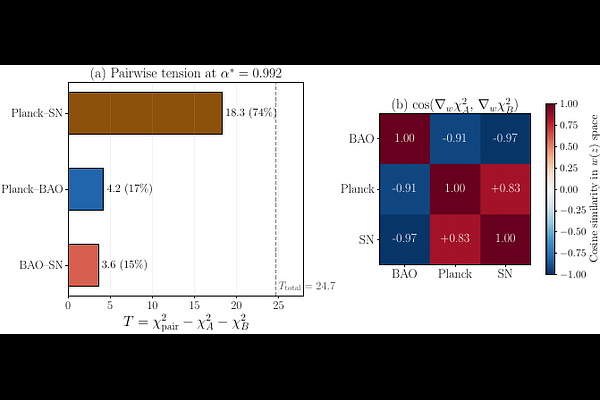
AbstractWe identify a geometric obstruction to resolving the Hubble tension by combining early-time sound-horizon reduction with late-time smooth dark energy. Within $Λ$CDM, the BAO--SN matter-density gap $ΔΩ_m = 0.037$ is exactly invariant under the sound-horizon rescaling $α\equiv r_s^{\rm mod}/r_s^{Λ{\rm CDM}}$, and late-time $w(z)$ deformations cannot eliminate this gap either: reconciling the two datasets requires \emph{opposite} deformations -- phantom ($w < -1$) for BAO, quintessence ($w > -1$) for SN at $z < 0.5$ -- an anti-alignment quantified by $\cosθ= -0.97$ in $w(z)$ space. A full MCMC analysis of DESI DR2 BAO, Planck plik\_lite, and Pantheon+ bears this out: the optimal $α^* = 0.992$ ($0.8\%$ $r_s$ reduction) brings the joint fit to $H_0 = 70.3 \pm 0.3\;\mathrm{km\,s^{-1}\,Mpc^{-1}}$, still $3.2σ$ below SH0ES, with the inter-dataset tension reduced but not removed. The obstruction reflects not a shortage of model freedom but an irreducible disagreement between probes. The deformation space $\{α, β_{\rm damp}, w(z)\}$ already spans $93\%$ of the $Ω_m$ response direction; nonetheless BAO and SN constrain $Ω_m$ through independent channels and disagree, while the residual $H_0$ deficit, anchored by the local distance ladder, resides in the absolute distance scale that $w(z)$ reshapes but cannot rescale.