Microbial community composition, but not diversity, influence microbial necromass mineralization

Microbial community composition, but not diversity, influence microbial necromass mineralization
L'Esperance, E.; Poirier, V.; Yergeau, E.
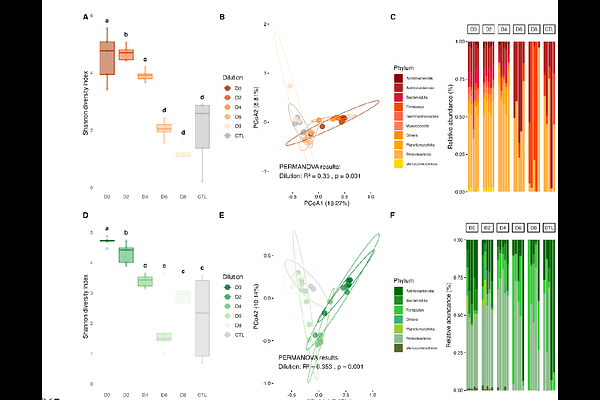
AbstractSoil harbours a wide diversity of microbes responsible for essential functions, such as depolymerizing the C and N in organic matter through the production of exoenzymes. Some of these exoenzymes are universal, whereas others are specific to certain microbes. We hypothesized that higher microbial alpha diversity is associated with greater depolymerization capacity, specifically for protein and cellulose depolymerization, which will result in more N being mineralized. We therefore diluted two soil microbial communities, one from a forest soil and one from an agricultural soil, to create a diversity gradient. After nine weeks, we transferred these communities to a synthetic soil in which microbial necromass was the only nitrogen source. Before the transfer and two weeks after, we quantified protease, deaminase and {beta}-glucosidase potential activity, characterized the bacterial and fungal communities, and measured the quantity of nitrogen mineralized. The dilution had very little effect on the processes measured, with no clear trend. For identical alpha diversity values, some communities had high process rates, while other not. It appeared that these communities varied widely, a side effect of the dilution approach, and that this variation was significantly linked to process rates. This shows that community composition (beta diversity) is more strongly related to enzymatic potential and mineralization than species richness (alpha diversity) following necromass addition. In conclusion, the relationship between diversity and depolymerization of microbial necromass is not simply a matter of a linear decrease along with diversity but is rather linked to how reduced diversity results in more stochastic microbial communities.