Parametrizing the projected wind fields of ultra-hot Jupiters in thermal emission: an application to GCM spectra of WASP-76b

Parametrizing the projected wind fields of ultra-hot Jupiters in thermal emission: an application to GCM spectra of WASP-76b
Joost P. Wardenier, Romain Allart, Georgia Mraz, Louis-Philippe Coulombe, Frédéric Genest, Vigneshwaran Krishnamurthy, Enola Quenet, Vincent Yariv
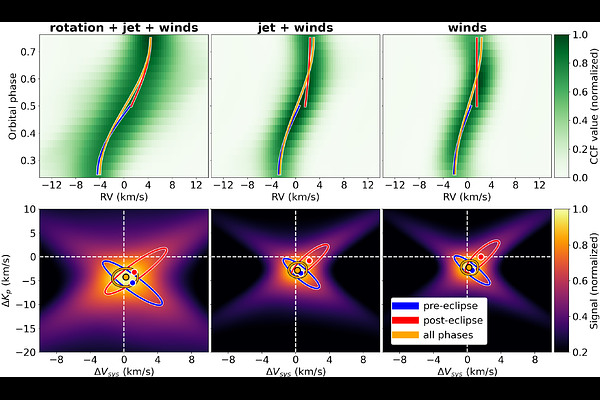
AbstractHigh-resolution thermal emission spectroscopy provides a powerful probe of atmospheric circulation in ultra-hot Jupiters (UHJs), with Doppler shifts encoding information about the 3D wind field across the planet disk. Retrieving these wind properties from phase-dependent emission spectra requires a forward model that is both physically motivated and computationally tractable. We present dopplerkernel, a new forward model that parametrizes the projected line-of-sight velocity field on the planet disk using four wind parameters (an equatorial jet speed $v_\mathrm{jet}$ and width $σ_\mathrm{jet}$, a source-to-sink flow speed $v_\mathrm{wind}$, and a flow convergence longitude $\varphi_\mathrm{sink}$) and constructs a broadening kernel via weighted kernel-density estimation. We apply this framework in a Bayesian retrieval to synthetic $K$-band emission spectra of WASP-76b generated from three 3D GCM outputs. Our retrievals successfully recover the equatorial jet in the drag-free GCM to within ${\sim}1$ km/s of the zonal mean and infer day-to-night wind speeds in good agreement with GCM averages at 1-10 mbar for all three drag regimes. We find that spectral resolutions of $R \sim 100{,}000$ offer an optimal trade-off: sufficient to resolve global wind features while avoiding spurious detections caused by model-data mismatches at higher resolution. Combining pre- and post-eclipse phases yields more reliable constraints than either alone, particularly on the orientation of the source-to-sink flow. Experiments with more complex weight functions reveal a degeneracy between the velocity field and the thermal weighting, cautioning against overparametrization. In conclusion, a parametric broadening-kernel model with a small number of physically interpretable parameters can accurately reproduce the phase-dependent line shifts, shapes, and strengths in UHJ emission spectra.