Harmonic phase diagnostics of long secondary periods. Testing predictions of oscillatory convective dipole modes in the OGLE sample

Harmonic phase diagnostics of long secondary periods. Testing predictions of oscillatory convective dipole modes in the OGLE sample
Benjamin Courtney-Barrer, Xavier Haubois, Michael Ireland, Peter Wood
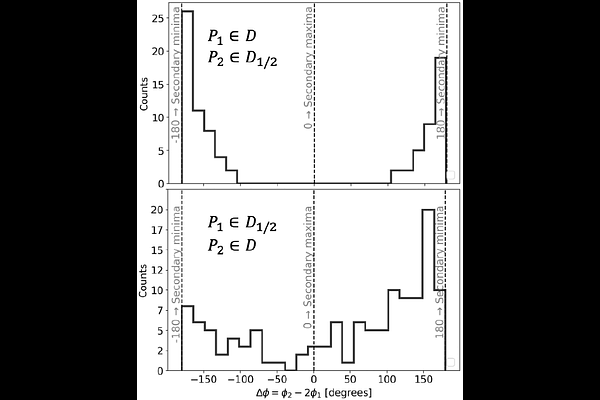
AbstractLong secondary periods (LSPs) in luminous red giants remain the only major class of long-period stellar variability without a secure physical origin. Competing hypotheses include binaries with dusty companions and oscillatory convective dipole modes. We identify the physical and geometric conditions under which oscillatory convective dipole modes produce distinctive harmonic signatures that contrast with those expected from binary systems, and apply this diagnostic to a filtered subset of the OGLE-III LSP sample to identify examples consistent with oscillatory convective dipole modes. We model the geometric flux modulation from oscillatory convective dipole modes and map the range of inclinations, temperature amplitudes, and observing wavelengths for which harmonic features are observable. Using OGLE-III I-band light curves, we require statistically significant power at both sequence D and its harmonic, keeping a filtered sample of 249 stars (2.1\% of the ridge-selected sample). We apply iterative Lomb-Scargle and weighted Fourier decomposition to isolate the fundamental and harmonic components. The relative phase ($Δφ$) between these distinguishes secondary maxima predicted by an inclined dipole from secondary minima caused by eclipsing or ellipsoidal binary systems.The majority of high amplitude stars in the filtered subset show $Δφ$ consistent with secondary minima produced by binary systems. However, a small but statistically non-negligible subset exhibits $Δφ$ consistent with secondary maxima that are difficult to reconcile by eclipsing or ellipsoidal binaries, and instead match the geometric predictions for highly inclined, non-rotating oscillatory convective dipole modes with temperature amplitudes consistent with published models.