IntravChip: a vascularized and perfused microfluidic model of the primary tumor microenvironment to collect intravasated tumor cells

IntravChip: a vascularized and perfused microfluidic model of the primary tumor microenvironment to collect intravasated tumor cells
Floryan, M.; Cordiale, A.; Jensen, H.; Chen, J.; Guo, Z.; Vinayak, V.; Kheiri, S.; Raman, R.; Shenoy, V.; Cambria, E.; Kamm, R.
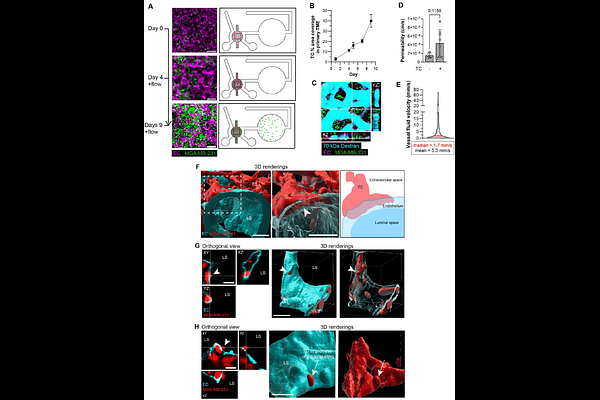
AbstractHematogenous metastasis is initiated when tumor cells (TCs) intravasate into the vasculature, yet intravasation remains poorly understood because it is difficult to observe in vivo and intravasated TCs are challenging to isolate. To address these challenges, we developed IntravChip, a continuously perfused microfluidic platform containing a vascularized primary tumor microenvironment (TME) enabling the observation of TC intravasation, and a downstream chamber to collect intravasated TCs. The IntravChip can support a high TC concentration in the TME while maintaining complete vascular perfusion, which we found was necessary to collect intravasated cells. Using MDA-MB-231 breast TCs, we identified an optimal initial TC seeding density that, by day 9, yields a densely populated TME and 100-440 collected intravasated TCs. We validated the IntravChip across several TC types, showing that MDA-MB-231 and MV3 TCs have the highest intravasation rates while MCF-7 TCs have low intravasation efficiency. We also show that the IntravChip is compatible with super-resolution nano-imaging. Our devices enabled high-quality STORM imaging, which revealed that H3K9me3 nanodomains are significantly differentially distributed in intravasated MDA-MB-231 tumor cells compared to those residing in the TME. Finally, the IntravChip was validated as a platform to test the effects of anti-cancer drugs on tumor cells and on the vasculature. We showed that a 5 M concentration of sorafenib reduced intravasation events by 69% without impacting the morphology of the microvascular networks (MVNs), while a 10 M concentration led to a significant decrease in vessel diameter. This platform enables quantitative analysis of TC intravasation, collection of intravasated TCs for characterization, and screening of anti-metastatic therapies.