The "dark dips" phenomenon in the LSST Camera on-sky images

The "dark dips" phenomenon in the LSST Camera on-sky images
Claire Juramy, Pierre Antilogus, Pierre Astier, John Banovetz, Sean Patrick MacBride, Andrew P. Rasmussen, Yousuke Utsumi
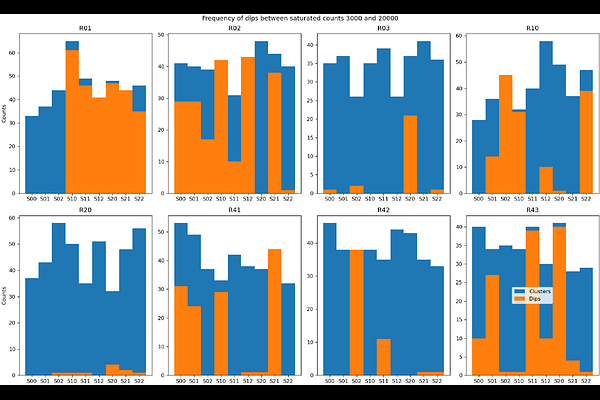
AbstractWhen the commissioning camera (ComCam), and then the LSST Camera, started taking on-sky images at the Vera Rubin Observatory, some of the ITL STA3800 CCDs exhibited a previously undocumented effect. When a sufficiently bright star is superimposed over the sky background, the sensor columns that contain the star appear slightly darker than the background, both above and below the position of the star. The visual appearance of these "dark dips" in the background is enhanced by a slight excess of flux within the neighboring columns, suggesting that they are caused by a lateral field distortion that shifts charges away from the central columns. This effect is not uniform across sensors, reaching an amplitude of up to seven percent of the background in the worst cases, but being undetectable in other sensors under the same conditions. For the affected sensors, the threshold required for the dips to become detectable also varies, from a few hundred to a few thousands saturated pixels within the star footprint. We developed means to quantify the dips, and studied the effect statistically over hundreds of frames, in order to categorize each sensor. In particular, we found no significant dependence on the filter color. We then developed a strategy to dynamically mask the affected columns during the Instrument Signature Removal process, to avoid any potential effect on photometric and astrometric performance.