OGHReS: Discovery of a giant hub-filament system at the edge of the Galactic molecular disc

OGHReS: Discovery of a giant hub-filament system at the edge of the Galactic molecular disc
J. S. Urquhart, A. Y. Yang, M. A. Thompson, C. Koenig, D. Colombo, W. -J. Kim, A. Giannetti, A. Karska, F. Wyrowski, M. Figueira, T. J. T. Moore, L. K. Morgan, Enrique Vázquez-Semadeni
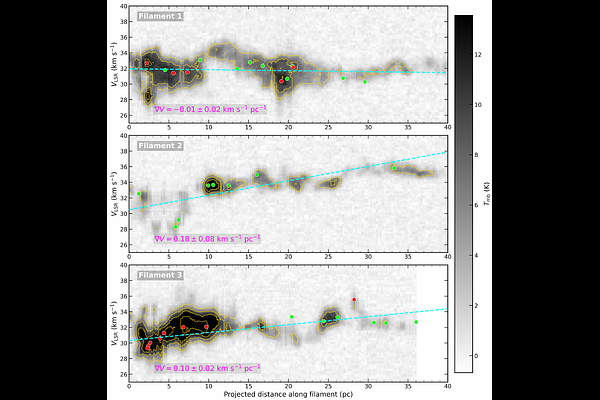
AbstractWe present the discovery and characterisation of G195.65$-$0.10 (also known as the $λ$-complex), a giant hub-filament system identified by the Outer Galaxy High Resolution Survey (OGHReS). The complex contains 61 spatially and kinematically coherent HiGAL clumps with a mean velocity of $V_{\rm LSR}=32.85$ km/s and a velocity dispersion between clumps of 1.97 km/s. A $Gaia$ parallax measurement of the central emission-line star MWC 137 associated with an embedded cluster gives a heliocentric distance of 5.2$^{+0.8}_{-0.6}$ kpc, placing the complex at a Galactocentric radius of 13.2 kpc. The molecular structure spans approximately $35\times63$ pc and contains $\sim 1.6\times10^{5}$ M$_\odot$ of molecular gas, including $\sim 5 \times 10^{4}$ M$_\odot$ in dense clumps. The molecular emission is organised into three prominent velocity-coherent filaments that converge on a dense central hub. Of the associated clumps, 16 are protostellar and 45 are gravitationally bound but currently starless. The protostellar clumps are significantly more concentrated towards the hub than the starless population, with median projected offsets of 6.65 and 15.83 pc, respectively. Moreover, the luminosity-to-mass ratio of the protostellar clumps decreases significantly with increasing distance from the hub, indicating that the most evolutionarily advanced sources are preferentially located in the central region. These results reveal a systematic concentration of dense gas and increasingly evolved star formation towards the hub, with organised large-scale gas motions throughout the filamentary network. The $λ$-complex therefore provides an unprecedented laboratory to understand hierarchical and high-mass star formation in the outer Galactic disc.