LCS: A Learnlet-Based Sparse Framework for Blind Source Separation

LCS: A Learnlet-Based Sparse Framework for Blind Source Separation
V. Bonjean, A. Gkogkou, J. L. Starck, P. Tsakalides
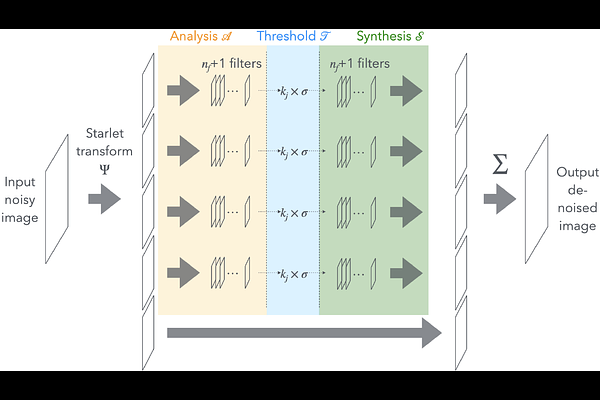
AbstractBlind source separation (BSS) plays a pivotal role in modern astrophysics by enabling the extraction of scientifically meaningful signals from multi-frequency observations. Traditional BSS methods, such as those relying on fixed wavelet dictionaries, enforce sparsity during component separation, but may fall short when faced with the inherent complexity of real astrophysical signals. In this work, we introduce the Learnlet Component Separator (LCS), a novel BSS framework that bridges classical sparsity-based techniques with modern deep learning. LCS utilizes the Learnlet transform: a structured convolutional neural network designed to serve as a learned, wavelet-like multiscale representation. This hybrid design preserves the interpretability and sparsity, promoting properties of wavelets while gaining the adaptability and expressiveness of learned models. The LCS algorithm integrates this learned sparse representation into an iterative source separation process, enabling effective decomposition of multi-channel observations. While conceptually inspired by sparse BSS methods, LCS introduces a learned representation layer that significantly departs from classical fixed-basis assumptions. We evaluate LCS on both synthetic and real datasets, demonstrating superior separation performance compared to state-of-the-art methods (average gain of about 5 dB on toy model examples). Our results highlight the potential of hybrid approaches that combine signal processing priors with deep learning to address the challenges of next-generation cosmological experiments.