Active removal of inhibitory components drives the flagellarType III Secretion Specificity Switch

Active removal of inhibitory components drives the flagellarType III Secretion Specificity Switch
Hughes, K. T.; Chevance, F. F. V.; Niketic, D.; Wu, D.; Mellor, C. T.; Blair, D. F.; Casjens, S. R.; Kinoshita, M.; Minamino, T.; Namba, K.
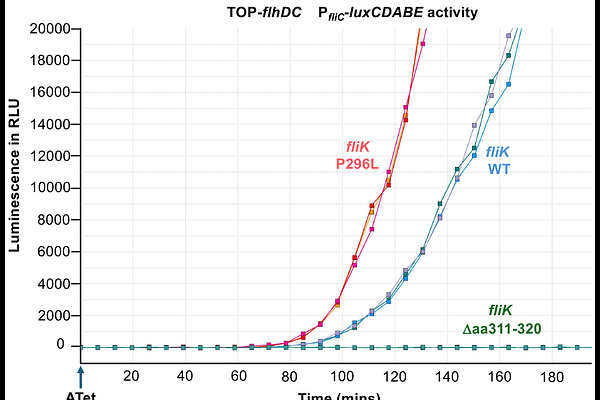
AbstractType III secretion (T3S) systems assemble bacterial nanomachines, including the flagellum and virulence-associated injectisomes, by exporting distinct classes of substrates in a defined temporal order. In both systems, completion of an early assembly intermediate triggers an irreversible switch from early to late substrate secretion. In the flagellar system, this switch is controlled by the secreted molecular ruler FliK acting on the core T3S component FlhB, but the molecular mechanism governing this transition has remained unclear. Here we show that removal of two components, Fluke and the cleaved C-terminal domain of FlhB (FlhBCCD), locks the secretion apparatus in a constitutive late secretion state. In these mutants, secretion specificity no longer requires completion of the hook-basal body or the FliK ruler, indicating that Fluke and FlhBCCD function to maintain the apparatus in early secretion mode. Consistent with this model, synchronized flagellar gene expression experiments reveal that FlhBCCD is retained during early assembly and is lost coincident with hook-basal body completion and activation of {sigma}28-dependent late gene expression of flagellin and chemosensory genes. Structural modeling of the FliK C-terminal switch domain and FlhBCCD supports a mechanism in which secretion of FliK promotes destabilization and ejection of FlhBCCD from the secretion apparatus. Disruption of a folded region within FliK switch domain uncouples secretion from switching, indicating that the timing of FliK unfolding during secretion is critical for activation of the specificity switch. These findings show that secretion specificity switching is driven by FliK-dependent removal of inhibitory components, rather than passive sensing of assembly completion.