Finding Strongly Lensed Supernovae from Blended Light Curves

Finding Strongly Lensed Supernovae from Blended Light Curves
Sangwoo Park, Arman Shafieloo, Alex G. Kim, Eric V. Linder, Xiaosheng Huang
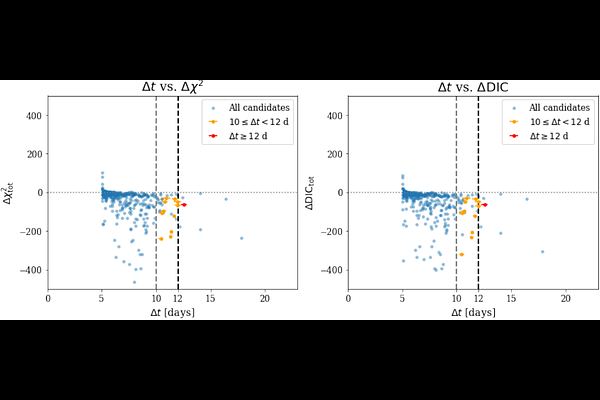
AbstractWe present a model-independent, photometry-only framework for identifying strongly lensed supernovae when multiple images are unresolved and blended into a single point source. Building on the simulation-based methodology of Bag et al. (2021), we apply this approach to real Zwicky Transient Facility (ZTF) data using a validation sample of spectroscopically confirmed Type Ia supernovae. The method models the observed flux as a superposition of two time-shifted components, and Bayesian inference is used to estimate the relative scaling and time delay. Applying this framework to 445 well-converged supernovae, we find that only a single object satisfies the selection criteria when adopting a conservative threshold of $Δt \ge 12$ days, corresponding to a false positive fraction of $1/445 \approx 0.22\%$. A laxer threshold of $Δt \ge 10$ days yields fourteen objects, for a false positive fraction of $3.15\%$. The method provides a scalable and model-independent first-stage filter for identifying lens-like candidates in large time-domain surveys such as the Rubin Observatory's Legacy Survey of Space and Time (LSST).