Targeting neutrophil signaling networks in immune complex-mediated autoimmune disease

Targeting neutrophil signaling networks in immune complex-mediated autoimmune disease
Schlotfeldt, M.; Osterloh, C.; Kasprick, A.; Zünkeler, C.; Armbrust, M.; Kaiser, G.; Schulze Dieckhoff, K.; Mester, T.; Stüssel, P.; Ernst, N.; Schneider, A.-K.; Voss, L.; Mansini, A. P.; Vahabi, S. M.; Wang, Y. F.; Gainer, H.; Li, J. Q.; Vidarsson, G.; Visser, R.; Petersen, F.; Yu, X.; Amber, K. T.; Lux, A.; Ludwig, R. J.; Bieber, K.
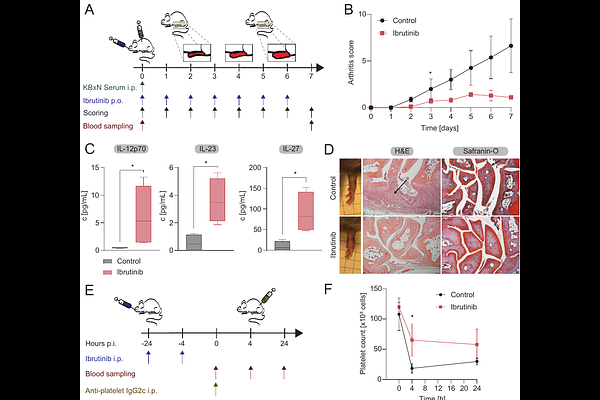
AbstractFragment crystallizable gamma receptor (Fc{gamma}R)-induced signaling is a crucial process that determines the cellular response to immune complexes (IC) in autoimmune diseases. In several diseases including pemphigoid diseases (PD), such as epidermolysis bullosa acquisita (EBA), or rheumatoid arthritis (RA), neutrophils are prominently involved as effector cells, while others such as immune thrombocytopenia (ITP) are independent of neutrophils. At the same time, most diseases are commonly treated by broad-range immunosuppression accompanied by severe risk for adverse effects. Signal transduction inhibitors (STIs) have been successfully applied in cancer therapy. However, their use in autoimmune diseases is an emerging, but so far understudied potential treatment avenue. Therefore, we screened a target-selective compound library consisting of 155 STIs in a neutrophil-based assay and conducted a multiplex kinase activity profiling with IC-stimulated neutrophils. Thus, we found novel potential therapeutic targets that were validated both in vitro in functional neutrophil assays and in vivo in murine models of EBA Here, we demonstrate that both systemic and topical treatment with several individual STIs is effective in a prophylactic approach in these models. Furthermore, therapeutic treatment with the BTK inhibitor ibrutinib in the immunization-induced EBA model reduced disease severity by approximately 85 % and showed efficacy in additional experimental models of EBA, arthritis, and ITP. Together, the present study contributes to the elucidation of Fc{gamma}R-dependent signaling in neutrophils and identifies multiple novel promising treatment options including inhibition of PLC, PDK-1, PKC, p38, DNA-PK, KSP, c-Met, TBK-1 and BTK for IC-mediated autoimmune diseases.