Mechanistic Insights into 2-5(H)-Furanone-Mediated Inhibition of Angiogenesis Using HUVECs and Zebrafish Models

Mechanistic Insights into 2-5(H)-Furanone-Mediated Inhibition of Angiogenesis Using HUVECs and Zebrafish Models
Vijay, A.; Bhagavatheeswaran, S.; Balakrishnan, A.
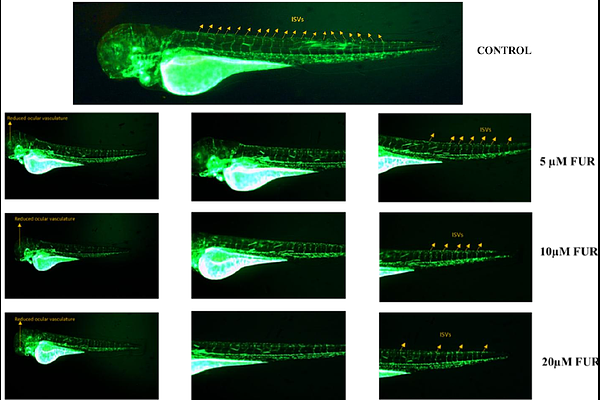
AbstractAngiogenesis, the process by which new blood vessels form from existing vasculature, is fundamental to tissue repair and regeneration but also underlies pathological conditions such as cancer progression. Targeting angiogenesis has thus become a promising approach for developing novel cancer therapeutics. While various phytochemicals have demonstrated anti-angiogenic effects, the role of 2-5(H)-Furanone, a naturally occurring lactone found in various plants and marine sources with diverse biological activities, remains insufficiently explored. In this study, we systematically evaluate the anti-angiogenic potential of 2-5(H)-Furanone using Human Umbilical Vein Endothelial Cells (HUVECs) as an in vitro model and zebrafish embryos as an in vivo model. Experimental findings demonstrated that treatment of HUVECs with increasing concentrations of 2-5(H)-Furanone led to significant, dose-dependent reductions in proliferation, invasion, migration, and tube formation. Analyses of gene expression revealed marked downregulation of key pro-angiogenic mediators, VEGF, and HIF-1. Complementing these in vitro results, in vivo studies in zebrafish embryos showed robust, dose-dependent inhibition of intersegmental vessel (ISV) formation, accompanied by suppression of critical angiogenesis-related genes. Molecular docking further supported these observations by indicating stable binding of 2-5(H)-Furanone to major angiogenic targets, including VEGFR2, MMP2, HIF-1, and PIK3CA. Collectively, our data demonstrate that 2-5(H)-Furanone potently inhibits angiogenesis, as evidenced in both HUVEC and zebrafish models, through functional and molecular mechanisms. These findings support the further development of 2-5(H)-Furanone as a promising anti-angiogenic therapy candidate.