Modeling the Impact of Starspot Inhomogeneity on Spectroscopic Retrievals of Directly-Imaged Planets

Modeling the Impact of Starspot Inhomogeneity on Spectroscopic Retrievals of Directly-Imaged Planets
Alex R. Howe, Natasha Latouf, Christopher C. Stark, Avi M. Mandel, Veselin Kostov
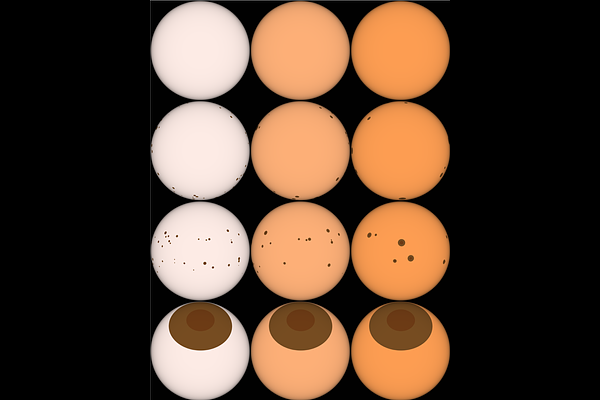
AbstractStellar activity is a major complication in the detection and characterization of exoplanets by both radial velocities and transits, and the upcoming Habitable Worlds Observatory (HWO) invites us to also consider its effect on direct imaging. Spectra of directly-imaged planets can vary with the activity of their host stars because the face of the star we see is not the same as the face reflected by the planet. This discrepancy could potentially result in inaccurate measurements of the planet's radius and unexpected, externally-caused variability in its contrast spectrum with the star. To assess the scientific capabilities and requirements of HWO, it is important that the magnitude of these effects be quantified. We present results of model retrievals of Earth-like exoplanets observed with an HWO-style survey, as they would appear when affected by starspots, using the ExoVista code for spectrum generation and the BARBIE code for spectroscopic retrieval. Both Solar-type stellar activity and highly active rapid rotators are considered and compared with an idealized quiescent host star. In the quiescent case, ${\rm SNR}\approx5$ is needed to detect atmospheric water vapor at 0.9 microns and ${\rm SNR}\approx13$ at 0.74 microns. We find that for Solar-type activity, the effect on retrievals will be negligible, but it could present problems for certain highly-active stars at limiting geometries. For an extreme case with a single large spot with 10\% coverage not visible to the observer, the SNR required for water detection increases to ${\rm SNR}\approx8$ at 0.9 microns and ${\rm SNR}\approx18$ at 0.74 microns. It also decreases the accuracy of the retrieved albedo, resulting in a value $\sim2/3$ of the true value. In light of these results, we estimate the impact that stellar variability and starspots may have on an HWO-style survey.