Proton Irradiation of Primitive Atmospheres of Young Exoplanets and early Earth: $N_{\mathrm{2}}O$ Greenhouse Warming and Prebiotic Synthesis

Proton Irradiation of Primitive Atmospheres of Young Exoplanets and early Earth: $N_{\mathrm{2}}O$ Greenhouse Warming and Prebiotic Synthesis
Kensei Kobayashi, Vladimir S. Airapetian, Takumi Udo, Shunsuke Mouri, Yoko Kebukawa, Hitoshi Fukuda, Yoshiyuki Oguri, Naoto Hagura, M. J. Way, Guillaume Gronoff, Eric T. Wolf
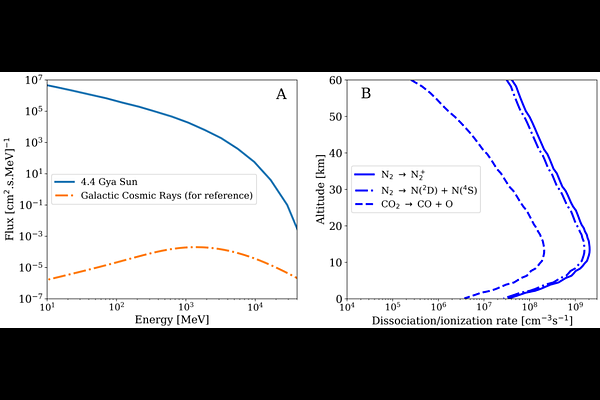
AbstractThe emergence of habitable conditions on the early Earth and on rocky exoplanets requires persistent energy sources that can drive both prebiotic chemistry and climate warming under magnetically active young G to M stars. To quantify the contribution of stellar energetic particle (StEP) events associated with superflares to the atmospheric chemistry of young planets with primitive atmospheres, we carried out a suite of laboratory proton irradiation experiments on mildly reduced gas mixtures. We present first proton irradiation experiments of $N_{\mathrm{2}}O$/$CO_{\mathrm{2}}$ rich gas mixtures that yield abundant nitrous oxide ($N_{\mathrm{2}}O$) at mixing ratios up to 1000 ppmv, together with amino acid precursors including glycine, corresponding to global production rates of order $2\times10^{10}$ kg/yr on the early Earth. Our photochemical modeling of StEP driven proton irradiation reproduces the experimentally inferred $N_{\mathrm{2}}O$ production rates and provides self-consistent atmospheric $N_{\mathrm{2}}O$ profiles. We then use these profiles of $N_{\mathrm{2}}O$ as input to a 3D global climate model to evaluate the radiative and climatic impact of StEP generated $N_{\mathrm{2}}O$ in primitive atmospheres representative of the early Earth and young rocky exoplanets. Our results show that frequent StEP events can help alleviate the faint young Sun paradox on the early Earth and can maintain temperate surface conditions on young rocky exoplanets beyond the outer edges of habitable zone, while simultaneously enhancing the buildup of prebiotic molecules. Together, these processes may constitute a robust pathway toward early planetary habitability.