The Impact of Fuzzy Dark Matter Dynamics on the Accumulation and Fragmentation of Primordial Gas

The Impact of Fuzzy Dark Matter Dynamics on the Accumulation and Fragmentation of Primordial Gas
Alexander Tocher, Anastasia Fialkov, Simon May, Ralf S. Klessen, Simon C. O. Glover, Paul C. Clark, Tibor Dome
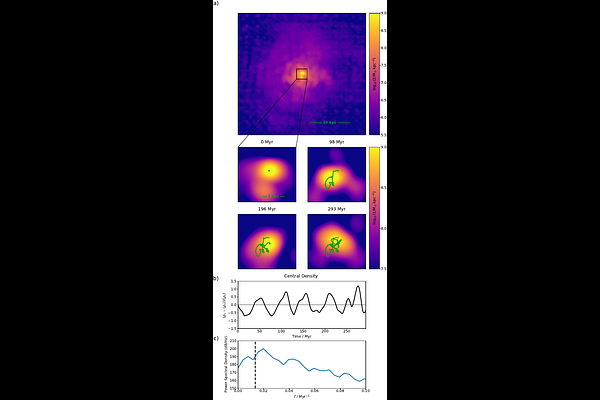
AbstractFuzzy Dark Matter (FDM), composed of ultra-light axions ($m_a \sim 1 \times 10^{-22}$ eV), exhibits wave-like properties that can significantly impact early-universe star formation. Using the arepo code with the axirepo module, we simulate the assembly of haloes across a range of axion masses ($1 \times 10^{-22}$ eV $\le m_a \le 7 \times 10^{-22} $ eV) and halo masses ($3 \times 10^{8} M_\odot \le M_h \le 8 \times 10^{9} M_\odot$). We investigate how small-scale dynamics of the FDM density field affect the accumulation of cold, dense gas. We find that the delay in star formation scales inversely with both halo mass and axion mass. While the static, cored geometry of the soliton primarily sets the timing of the initial collapse, we identify a secondary dynamical barrier driven by stochastic fluctuations that is most potent at the low-mass end of our parameter space. These dynamics dictate the spatial scale of dense gas by injecting kinetic energy and inducing significant angular momentum, which can rotationally stabilize gas out to the soliton radius. This wave-driven stirring leads to the formation of extended $\text{H}_2$ plumes and promotes dynamical mixing, effectively starving the central regions and forcing gas to cool in a more fragmented, diffuse manner. Our results indicate a shift from the monolithic central star formation seen in CDM toward lower-mass, fragmented clusters. These internal inefficiencies provide a physical mechanism for delaying Cosmic Dawn beyond the effects of the power spectrum cut-off, which is essential for refining observational constraints on the axion mass.