Euclid: Early Release Observations -- The formation of peanutty dwarf galaxies in Perseus

Euclid: Early Release Observations -- The formation of peanutty dwarf galaxies in Perseus
A. U. Kapoor, R. Smith, A. J. Zuiderwijk, S. De Rijcke, A. van der Wel, M. Baes, F. R. Marleau, P. -A. Duc, R. F. Peletier, B. Altieri, S. Andreon, N. Auricchio, C. Baccigalupi, M. Baldi, A. Balestra, S. Bardelli, P. Battaglia, A. Biviano, E. Branchini, M. Brescia, S. Camera, V. Capobianco, C. Carbone, J. Carretero, M. Castellano, G. Castignani, S. Cavuoti, K. C. Chambers, A. Cimatti, C. Colodro-Conde, G. Congedo, C. J. Conselice, L. Conversi, Y. Copin, F. Courbin, H. M. Courtois, M. Cropper, H. Degaudenzi, G. De Lucia, H. Dole, F. Dubath, X. Dupac, M. Fabricius, M. Farina, R. Farinelli, S. Ferriol, M. Frailis, S. Galeotta, K. George, B. Gillis, C. Giocoli, J. Gracia-Carpio, A. Grazian, F. Grupp, S. V. H. Haugan, J. Hoar, W. Holmes, I. M. Hook, F. Hormuth, A. Hornstrup, K. Jahnke, M. Jhabvala, S. Kermiche, A. Kiessling, B. Kubik, M. Kümmel, M. Kunz, H. Kurki-Suonio, A. M. C. Le Brun, S. Ligori, P. B. Lilje, V. Lindholm, I. Lloro, G. Mainetti, O. Mansutti, O. Marggraf, M. Martinelli, N. Martinet, F. Marulli, R. J. Massey, E. Medinaceli, S. Mei, M. Meneghetti, E. Merlin, G. Meylan, A. Mora, M. Moresco, L. Moscardini, R. Nakajima, C. Neissner, S. -M. Niemi, C. Padilla, S. Paltani, F. Pasian, K. Pedersen, W. J. Percival, V. Pettorino, G. Polenta, M. Poncet, L. A. Popa, F. Raison, A. Renzi, J. Rhodes, G. Riccio, E. Romelli, M. Roncarelli, R. Saglia, Z. Sakr, D. Sapone, P. Schneider, A. Secroun, E. Sihvola, P. Simon, C. Sirignano, G. Sirri, L. Stanco, P. Tallada-Crespí, A. N. Taylor, I. Tereno, S. Toft, R. Toledo-Moreo, F. Torradeflot, I. Tutusaus, J. Valiviita, T. Vassallo, A. Veropalumbo, Y. Wang, J. Weller, G. Zamorani, F. M. Zerbi, I. A. Zinchenko, E. Zucca, M. Magliocchetti, M. Sereno, F. Durret, D. Scott
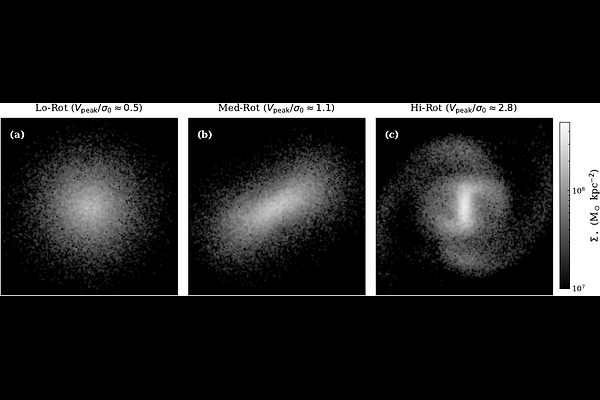
AbstractDwarf galaxies in dense cluster environments are susceptible to tidal interactions that can alter their morphology and kinematics. Boxy isophotes are well studied in massive galaxies but remain poorly understood in dwarfs. We aim to identify and characterise boxy/peanutty dwarf galaxies in the Perseus cluster and determine the origin of their isophotal shapes. Using Euclid Early Release Observations of the Perseus cluster, we present a cumulative light fraction method for robustly measuring the isophotal shape parameter $c_4$, particularly suited to low surface brightness regimes. From ~1100 cataloged dwarfs, we select a clean sample of ~190 early-type systems with reliable $c_4$ measurement. Observed trends are interpreted through comparison with mock Euclid observations of $N$-body simulations of tidally transformed dwarfs. We identify 13 dwarfs with significantly boxy isophotes ($c_4 < -0.0175$). These galaxies lack visible thin disks, lie on the cluster red sequence, and show no preferential spatial concentration within Perseus. We find a significant anticorrelation between $c_4$ and effective radius: larger galaxies exhibit more boxy isophotes. An analogous size-shape anticorrelation is recovered in the simulations, where inner regions are dominated by box orbits associated with a triaxial peanut structure and outer regions by short-axis tube orbits. The boxy dwarfs in Perseus are tidally transformed remnants of moderately rotating progenitors, with boxy isophotes tracing inner box-orbit-dominated peanut structures. The size-shape correlation arises from viewing geometry: face-on orientations reveal the rectangular profile of the elongated triaxial structure (large and boxy), while edge-on views yield rounder, compact morphologies. Our sample represents an orientation-selected subset of tidally transformed, peanutty dwarfs in the cluster.