IFNγ at the crossroads of systemic protection and brain vulnerability to coronavirus infection

IFNγ at the crossroads of systemic protection and brain vulnerability to coronavirus infection
Sabater, A.; Arevalo, A. P.; Perbolianachis, P.; Sanchis, P.; Pascual, G.; Porfido, J. L.; Seniuk, R.; Portela, M.; Valacco, M. P.; Cotignola, J.; Vazquez, E.; Labanca, E.; Carballeda, J. M.; Moreno, P.; Moratorio, G.; Crispo, M.; Gueron, G.; Toro, A.
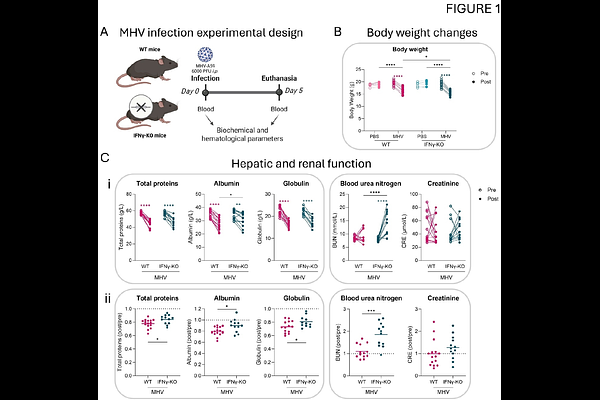
AbstractThe COVID-19 pandemic, together with previous outbreaks caused by highly pathogenic coronaviruses, highlighted the importance of understanding the host determinants that influence pathogenesis, both to improve our understanding of disease mechanisms, and to strengthen preparedness for future outbreaks. In our previous work we demonstrated dysregulation of IFN{gamma} response genes in COVID-19 patients, associated with both age and viral burden, positioning IFN{gamma} as a key mediator of host defense against SARS-CoV-2. Here, we used a preclinical murine model of coronavirus infection based on murine hepatitis virus (MHV-A59), widely validated for studying SARS-CoV-2 pathogenesis, together with IFN{gamma} knockout (IFN{gamma}-KO) mice to investigate the role of this cytokine during infection. We performed a comprehensive morphological, biochemical, hematological and proteomic characterization of infected wild-type (WT) and IFN{gamma}-deficient mice. Plasma proteomics revealed impaired inflammatory and coagulation-related responses in IFN{gamma}-KO animals compared to WT controls. We found increased viral load and infectious particles in peripheral organs, including liver, spleen, heart and muscle in IFN{gamma}-KO mice, whereas these were significantly reduced in the brain. Region-specific analysis further demonstrated decreased viral load in the prefrontal cortex and hippocampus of IFN{gamma}-KO animals. Consistently, bioinformatics analysis of transcriptomics data of IFN{gamma}-treated primary neuron cultures, together with frontal cortex from human COVID-19 patients, revealed activation of neuroinflammatory and neurological disease-associated pathways, supporting a role for IFN{gamma} in driving brain inflammatory responses during coronavirus infection. Together, these findings reveal a dual role for IFN{gamma} during coronavirus infection: it is important for controlling systemic viral dissemination and limiting peripheral tissue damage, yet it may also promote viral susceptibility and exacerbated inflammatory responses in the brain. These results support IFN{gamma} modulation as a potential therapeutic strategy to prevent or mitigate neurological complications associated with COVID-19.