Co-dissemination of anti-phage defence systems and multidrug resistance is associated with the seventh-pandemic Vibrio cholerae defensome

Co-dissemination of anti-phage defence systems and multidrug resistance is associated with the seventh-pandemic Vibrio cholerae defensome
Hoque, M. M.; To, J.; Leo, D.; McDougald, D.; Matson, J. S.; Espinoza-Vergara, G.
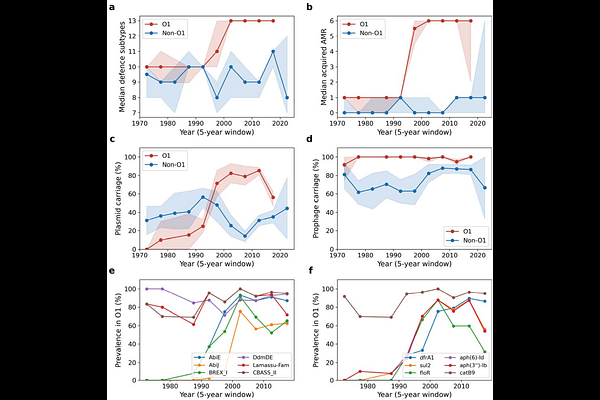
AbstractAnti-phage defence systems in Vibrio cholerae are increasingly recognised as cargo on mobile genetic elements (MGE) that also carry antimicrobial resistance (AMR) and virulence genes, but a population-scale view of how the V. cholerae defensome partitions between the pandemic O1 clade and the environmental non-O1 reservoir has been missing. We analysed 1,740 RefSeq V. cholerae genomes (773 O1, 967 non-O1) sampled from 1934 to 2022 across 60 countries. The non-O1 reservoir harboured 283 defence subtypes and 55 families absent from any O1 genome. O1 was dominated by abortive infection systems (33.5% vs 14.0% in non-O1; P < 0.001). Defence and prophage burden were inversely related within O1 (R = -0.15) but weakly positive in non-O1, and an 80-year reconstruction revealed mirror trajectories of rising defence diversity and declining prophage burden in O1, coincident with the emergence of SXT/R391 ICE-borne AMR. A bipartite network identified strong defence-AMR associations (Phi up to 0.80), nominating AbiE, AbiJ, dCTPdeaminase, Menshen, Retron-I_A and Lamassu-Fam as candidate co-acquired cargo. UMAP clustering resolved seven distinct defensome lineages, and a Random Forest classifier trained on the defence profile alone predicted-MDR (genotypic MDR) status with pooled cross-validated AUC of 0.96, AUC of 0.92 within O1 only and 0.93 within non-O1 only and generalised across decades (AUC = 0.88) and regions (AUC = 0.92); a five-system signature (AbiE, BREX-I, CBASS-II, dCTPdeaminase, AbiJ) achieved AUC = 0.91. These data implicate the AMR-bearing mobilome rather than phage predation as the principal driver of anti-phage defence evolution in pandemic V. cholerae, and support further evaluation of the defensome as a genomic correlate of multidrug resistance for surveillance use, pending validation in prospectively phenotyped cohorts.