Sirtuin 1 Is Required for Optimal Mammarenavirus Multiplication

Sirtuin 1 Is Required for Optimal Mammarenavirus Multiplication
Witwit, H.; Khafaji, R.; Mingo-Casas, P.; Blazquez, A. B.; Martin-Acebes, M. A.; de la Torre, J. C.
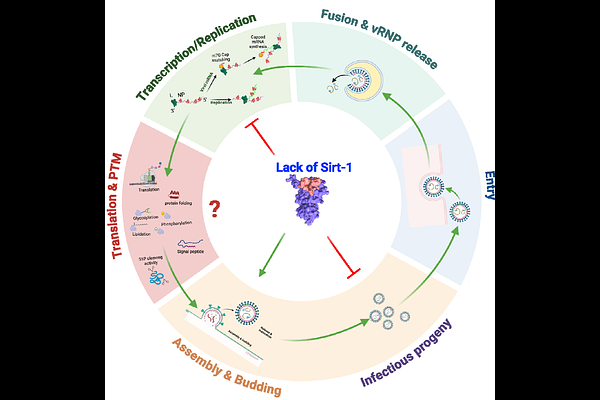
AbstractMammarenaviruses (MaAv) cause persistent infections in diverse rodent reservoirs worldwide and several are zoonotic pathogens with an important public-health burden in their endemic regions. Moreover, the globally distributed MaAv lymphocytic chori-omeningitis virus (LCMV) is an underrecognized pathogen of clinical significance in congenital infections and immunocompromised individuals. The lack of FDA-approved vaccines or antivirals for MaAv infections underscores the urgent need for novel an-ti-MaAv therapeutic strategies. Neutral sphingomyelinase 2 (nSMase2) was recently identified as a host factor contributing to LCMV multiplication, and its inhibitor cambinol exhibits dose-dependent antiviral activity against LCMV but the underlying mechanisms remain undefined. Here, we show that cambinol disrupts multiple stages of the LCMV life cycle. Cambinol inhibits the pH-dependent fusion event mediated by MaAv glycopro-tein, a step required for completion of virus cell entry. It also reduces viral ribonucleo-protein (vRNP)-directed genome replication and transcription and impairs the budding activity of the virus matrix Z protein. Cambinol also inhibits sirtuins 1 and 2 (Sirt-1 and Sirt-2), two NAD-dependent protein deacetylases with pleiotropic roles in cellular me-tabolism and stress responses, raising the question of whether cambinol anti-LCMV ac-tivity reflects nSMase2 inhibition alone or also involves sirtuin-dependent pathways. LCMV multiplication was significantly reduced in SIRT1, but not SIRT2, knockout (KO) cells, uncovering a pro-viral role for Sirt-1 in the LCMV life cycle. Consistent with this finding, LCMV vRNP activity and production of infectious progeny were reduced in SIRT1 KO cells. These findings identify Sirt-1 as a host factor required for optimal LCMV multiplication. Sirt-1 inhibitors are in clinical development for oncological and neuro-logical indications, raising the possibility of repurposing Sirt-1 inhibitors as host-directed antivirals (HDAs) against human pathogenic MaAv.