Horizontal transfer promotes allele segregation in multicopy plasmids

Horizontal transfer promotes allele segregation in multicopy plasmids
Hartmann, L. M.; Santer, M.; Huelter, N. F.; Dagan, T.
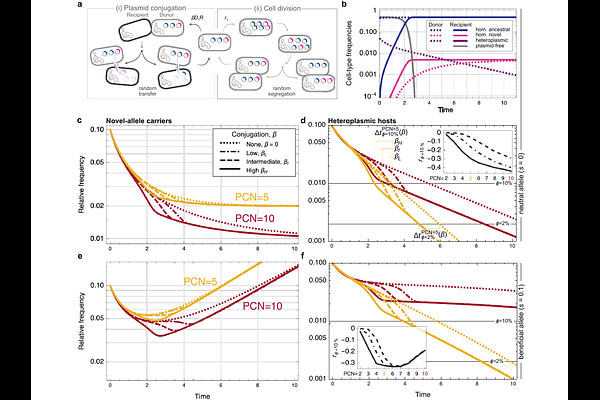
AbstractPlasmids reside within prokaryotic cells in multiple copies and can spread horizontally between hosts. Their multicopy nature enables intracellular allele diversity (heteroplasmy), and their segregation depends on the modes of plasmid replication and partition. Horizontal plasmid transfer has the potential to alter plasmid allele composition, however its impact on plasmid allele dynamics remains poorly understood. Here, we show that conjugative plasmid transfer accelerates the segregation of plasmid heteroplasmy by promoting the emergence of homoplasmic hosts. Using a quantitative experimental system to track plasmid allele dynamics in Acinetobacter baylyi under non-selective conditions, we followed the fate of a novel antibiotic resistance allele introduced into an ancestral donor population. While alleles in heteroplasmic donors segregated over time, conjugation produced almost only homoplasmic recipients whose allele composition closely mirrored that of the donor pool. Heteroplasmic recipients were rare and arose primarily from multiple plasmid transfer events prior to plasmid establishment. A mathematical model calibrated to the experimental setup predicts that conjugation accelerates plasmid allele segregation, with effects scaling with plasmid copy number and conjugation frequency. Our findings identify horizontal transfer as a previously unrecognized segregation pathway shaping the evolution of mobile genetic elements.