Selecting Optimal Stellar Calibration Fields for the CSST Imaging Survey

Selecting Optimal Stellar Calibration Fields for the CSST Imaging Survey
Chenxiaoji Ling, Juanjuan Ren, Li Shao, Zhimin Zhou, Peng Wei, Youhua Xu, Jinyu Hu, Xin Zhang, Su Yao, Hu Zhan, Chao Liu
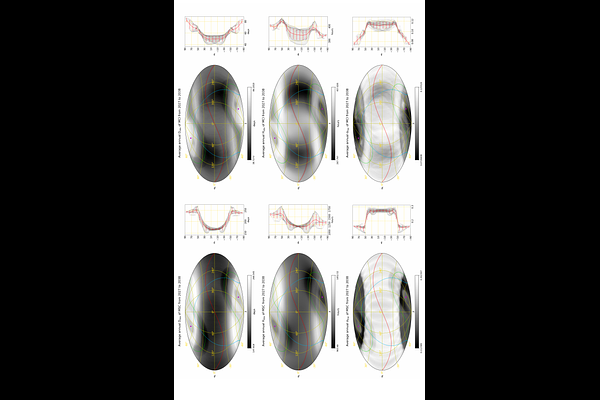
AbstractThe Chinese Space Station Survey Telescope (CSST) will perform a decade-long high-precision wide-field imaging survey that relies on rigorous on-orbit calibration. This necessitates stable celestial benchmark fields to maintain photometric and astrometric consistency throughout the mission lifetime. We establish comprehensive selection criteria including observational visibility, stellar number density, bright-star contamination, and interstellar dust extinction. Using the CSST Observation Strategy Analysis Tool (COSAT) and all-sky dust maps from Planck and SFD, we constrain eligible regions to the ranges of ecliptic latitude $ |β| > 50^\circ$ and galactic latitude $|b| > 15^\circ$. From an initial sample of 29 candidate clusters meeting these spatial constraints, six globular clusters (M13, M92, NGC 104, NGC 362, NGC 1261, and NGC 1851) are identified as optimal calibration fields, fulfilling all the critical criteria. These selected clusters are recommended as optimal calibration field candidates for CSST's on-orbit calibration program, and are fundamental to achieving unprecedented photometric precision in CSST's space-based survey.