Oral Gut Microbial Axis in Inflammatory Bowel Disease and Primary Sclerosing Cholangitis

Oral Gut Microbial Axis in Inflammatory Bowel Disease and Primary Sclerosing Cholangitis
Ke, S.; Zhou, Z.; Yin, X.; Yang, Y.; Sun, Z.; Quevedo, F.; Javier, N.; Dave, M.; Wu, K.; Mahmood, S. D.; Liu, Y.-Y.; Korzenik, J. R.
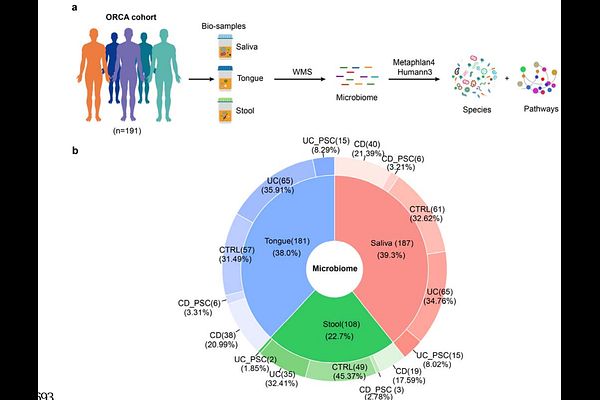
AbstractThe oral cavity is increasingly recognized as a reservoir of microbes that can translocate to and influence the gut microbiome. This oral gut microbial axis may contribute to the pathogenesis of chronic gastrointestinal and hepatobiliary disorders, including inflammatory bowel disease (IBD) and its comorbidity, primary sclerosing cholangitis (PSC). To investigate the oral-gut microbial axis in IBD and PSC, we enrolled 191 participants spanning Crohns disease (CD), ulcerative colitis (UC), CD with PSC (CD_PSC), UC with PSC (UC_PSC), and healthy controls. We generated and analyzed the whole metagenome shotgun sequencing data from saliva, tongue swabs, and fecal samples. Across oral and gut niches, we identified multiple microbial species differentially enriched in participants with UC compared with healthy controls, including Fusobacterium nucleatum and Gemella sanguinis in saliva, Catonella massiliensis and Tannerella serpentiformis on the tongue, and G. sanguinis and Sellimonas intestinalis in feces. Paired oral-gut analyses revealed 15 potential oral origin species enriched in fecal samples; notably, G. sanguinis and Veillonella rogosae were consistently enriched in participants with UC. These findings were further supported by an external validation dataset comprising 1,716 gut metagenomes from five independent IBD cohorts, highlighting the reproducibility of oral microbial signatures. In exploratory analyses, smoking history was associated with shifts in the oral microbiome toward a UC like state in healthy controls, suggesting a possible environmental modifier of the oral gut microbial axis. Collectively, our study identifies distinct oral microbial signatures and their potential translocation to the gut in IBD and PSC, underscoring the role of the oral gut microbial axis in disease progression.