Simulation of non X-ray background for the DIffuse X-ray Explorer (DIXE) mission

Simulation of non X-ray background for the DIffuse X-ray Explorer (DIXE) mission
Ruixuan Tian, Junjie Mao, Jiejia Liu, Hai Jin, Wei Cui
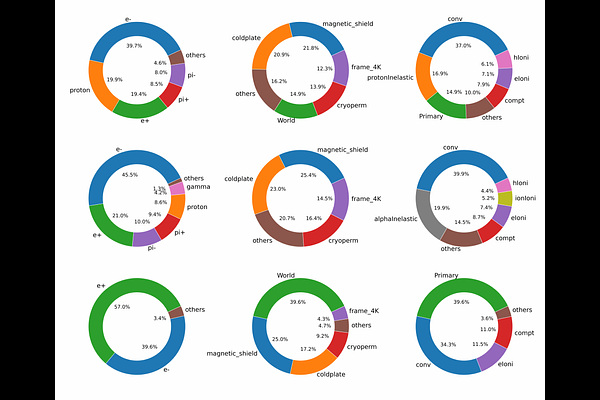
AbstractDIffuse X-ray Explorer (DIXE) is a proposed high-resolution spectroscopic survey mission onboard the China Space Station. Equipped with microcalorimeters based on the Transition-edge sensor technology, it aims to survey the hot gas in the Milky Way. The performance of DIXE depends on the understanding of non X-ray background (NXB), which can strongly affect observations of diffuse X-ray emission. In this work, we simulated the NXB of DIXE in a low-earth orbit (LEO) using \textsc{Geant4}. A detailed mass model of the payload was constructed, and the major sources of NXB were identified, including cosmic rays, albedo neutrons and albedo photons. These components were implemented in \textsc{Geant4} with realistic angular and spectral distributions. We simulated the relevant physical processes of space radiation interacting with the instrument and calculated the resulting NXB. We also evaluated the delayed background from trapped protons in the South Atlantic Anomaly (SAA). Our simulations show that, at the geomagnetic equator and under solar minimum conditions, the NXB is on average $4.46 \times 10^{-2} ~\mathrm{counts~s^{-1}~cm^{-2}~keV^{-1}}$ in 0.1--10 keV energy band, with dominant contributions from the induced particles generated by primary cosmic protons. The NXB increases toward higher geomagnetic latitudes, reaching a maximum of $1.55 \times 10^{-1} ~\mathrm{counts~s^{-1}~cm^{-2}~keV^{-1}}$. The delayed background induced by the SAA decays rapidly after exiting the anomaly and becomes negligible within approximately 5 minutes. The simulated NXB is consistent with that of similar X-ray observatories in LEOs.