HeteroRC: Decoding latent information from dynamic neural responses with interpretable heterogeneous reservoir computing

HeteroRC: Decoding latent information from dynamic neural responses with interpretable heterogeneous reservoir computing
Lu, R.; Liu, S.; Liu, Y.; Duncan, J.; Henson, R. N.; Woolgar, A.
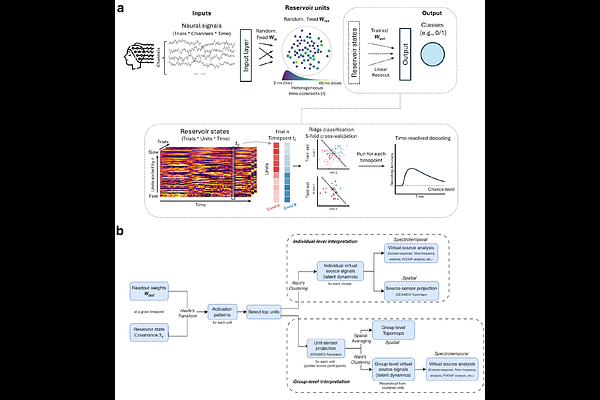
AbstractTime-resolved neural decoding is widely used to track information represented in neural activity, but conventional linear decoders primarily capture phase-locked evoked responses and often fail to recover representations embedded in nonlinear or non-phase-locked dynamics, potentially limiting the interpretation of neural coding. Here, we introduce HeteroRC, a biologically inspired and interpretable decoding framework based on heterogeneous reservoir computing. HeteroRC projects neural signals into a high-dimensional recurrent state space with heterogeneous time constants, enabling nonlinear feature expansion and multiscale temporal integration directly from raw neural time series. Simulations demonstrate that HeteroRC significantly outperforms linear decoders and a suite of artificial neural networks (including RNNs, LSTMs, Transformers and EEGNet) on evoked responses while robustly capturing induced oscillatory power, phase synchrony, and aperiodic modulations - dynamics that are largely latent to conventional linear methods. We further validate HeteroRC on two empirical EEG datasets. In a motor imagery task, it substantially improves decoding accuracy and exhibits superior cross-temporal generalisation, revealing dynamic representational transformations. In an attentional priority task, HeteroRC uncovers statistically learned spatial priority information that remains hidden from conventional methods, successfully decoding these latent states previously thought to be 'activity-silent'. Furthermore, we develop a dual-level interpretability framework linking reservoir dynamics to virtual sources and sensor space, revealing the temporal, spectral, and spatial signatures underlying decoding performance at both the individual and group levels. Together, HeteroRC offers an interpretable approach to decode information from dynamic neural responses, broadening the analytical scope of neural decoding while remaining computationally efficient and free from manual feature engineering, making it particularly suitable for small-sample electrophysiological studies.