Substructures in Planet-Forming Disks with the SKAO

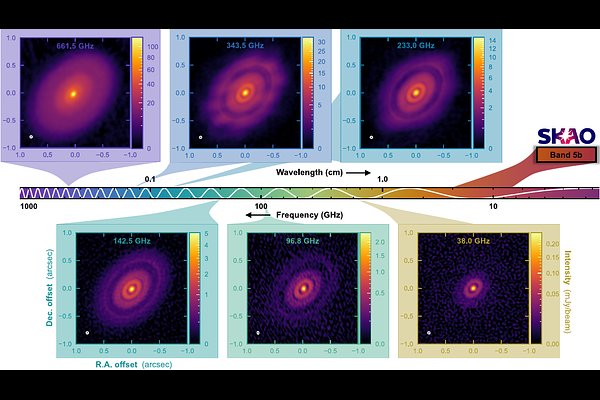
Substructures in Planet-Forming Disks with the SKAO
Yinhao Wu, Jessica Speedie, Sebastián Pérez, John D. Ilee, Takahiro Ueda, Claudia Toci, Daniel J. Price, Asmita Bhandare, Eleonora Bianchi, Tilman Birnstiel, Richard A. Booth, Tyler L. Bourke, Gemma Busquet, Simon Casassus, Yi-Xian Chen, Claudio Codella, Nicolás Cuello, Ruobing Dong, Antonio Garufi, Greta Guidi, Cassandra Hall, Haochang Jiang, Izaskun Jiménez-Serra, Hauyu Baobab Liu, Mayank Narang, Elenia Pacetti, Jaime Pineda, Paola Pinilla, Linda Podio, Danai Polychroni, Giovanni Sabatini, Eugenio Schisano, Leonardo Testi, Diego Turrini, Marion Villenave, David Wilner
AbstractDisks of gas and dust orbiting young stars are the arenas and material reservoirs for planet formation. Over the past decade, multiwavelength observations, from infrared to radio, have resolved the spatial distribution of hundreds of protoplanetary disks in nearby star-forming regions, revealing a diverse zoo of substructures. These substructures are morphological features such as rings, gaps, spirals, vortices, asymmetries, warps, or clumps that trace variations in density, temperature, or composition relative to an otherwise smooth distribution of gas and dust. Many unknowns persist as to the origin of these substructures, their role in planet assembly, and their true properties. SKA-Mid Band 5b continuum observations, offering angular resolutions of $\sim 0.05''$ ($\sim 0.15''$) with AA4 (AA*) at $12.5$ GHz / $2.4$ cm, will enable new progress at this frontier. In this chapter, we outline the open questions in the field of disk substructure that SKA-Mid is uniquely poised to address, with a lens on dust thermal emission.