Merger-driven buildup of the $M_{\rm BH}$ - $M_*$ relation bridging high-$z$ overmassive black holes with the local relation

Merger-driven buildup of the $M_{\rm BH}$ - $M_*$ relation bridging high-$z$ overmassive black holes with the local relation
Takumi S. Tanaka, John D. Silverman, Kazuhiro Shimasaku, Knud Jahnke, Junyao Li, Makoto Ando
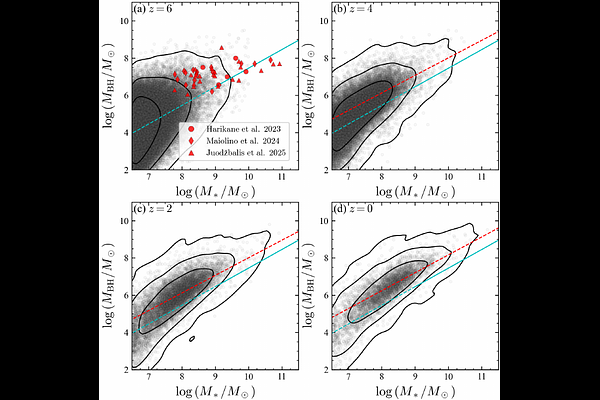
AbstractThe origin of the mass scaling relation between supermassive black holes (SMBHs, $M_{\rm BH}$) and galaxies ($M_*$) remains a key open question. Rather than invoking AGN feedback, a non-causal mechanism has been proposed in which multiple mergers average out the $M_{\rm BH}/M_*$ ratio, thus decreasing its scatter ($σ$) and forming a tight local mass relation over cosmic history. A larger scatter in the relation at higher redshift suggested from a non-causal evolutionary scenario may be evident from recent JWST observations of overmassive SMBHs at high redshift. Here, we carry out a Monte Carlo simulation of solely merger-induced evolution of galaxies and their SMBHs which incorporates recent high-redshift observational constraints on $σ$ and the galaxy merger rate. We find that the dispersion in the local mass relation can be reproduced, even when starting from a highly scattered population at $z\sim6$ with $σ=0.8\,{\rm dex}$ or $1.0\,{\rm dex}$, which are in agreement with recent JWST studies. The redshift evolution of the scatter is highly sensitive to the mass ratio between merging pairs and the merger rate, and minor mergers with higher frequency than major mergers can also contribute to the scatter evolution, highlighting the importance of accurately constraining these parameters at high redshift through observations. Furthermore, statistical surveys aimed at determining the $M_*$-dependence of $σ$ and constraining $σ$ at $z\sim3-4$ will be effective in testing this scenario.