Full one-fluid dusty gas with multiple grain species in SPH

Full one-fluid dusty gas with multiple grain species in SPH
Mark Hutchison, Guillaume Laibe, Giovanni Tedeschi-Prades, Timothée David-Cléris, Alex Barret, Maxime Lombart, Daniel J. Price, Christine M. Koepferl
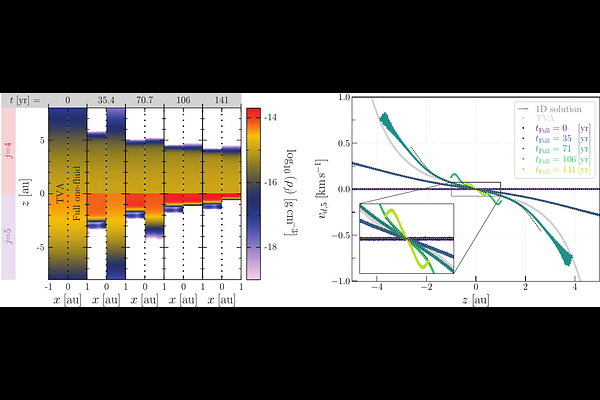
AbstractWe present a Smoothed Particle Hydrodynamics (SPH) implementation of the full one-fluid dusty gas algorithm for multiple dust species, generalising our previous terminal velocity approach to handle arbitrary drag regimes. By construction, mass, momentum, angular momentum, and energy are all conserved. We benchmark our method against a suite of tests -- DUSTYBOX, DUSTYWAVE, DUSTYSHOCK, DUSTYSETTLE, and DUSTYDISC -- each probing different aspects of the algorithm. Compared to the terminal velocity approximation, the full one-fluid approach incurs a computational cost increase of a factor of five to ten due to the added overhead of evolving the differential velocities and solving the drag terms implicitly. However, it accurately recovers analytic behaviour in regimes where the terminal velocity approximation fails. In such cases, errors from the terminal velocity approximation accumulate and propagate to other dust phases. We show that the stopping-time limiter commonly used in the terminal velocity approximation for numerical stability can substantially affect simulations containing large grains (Stokes numbers $\gtrsim 1$). While disabling the limiter leads to different outcomes, the discrepancy with the full one-fluid solution remains comparable, underscoring the importance of using a more general formulation for large grains. The full one-fluid formalism may be useful when including processes such as coagulation and fragmentation, where accurate treatment of large grains becomes essential. While the inability to model orbit-crossing dust trajectories remains a key limitation of the one-fluid formalism, this may eventually be addressed through the introduction of an effective dust pressure, mirroring how fluid models encapsulate microscopic velocity dispersion in gases.