Dissociation Between Genetic Risk and Transcriptional Output in Schizophrenia: A Cross-Tissue Meta-Analysis of CSMD1 and CSMD2 Expression

Dissociation Between Genetic Risk and Transcriptional Output in Schizophrenia: A Cross-Tissue Meta-Analysis of CSMD1 and CSMD2 Expression
Boughanmi, M.-E.; Leboyer, M.; Demily, C.; Rey, R.
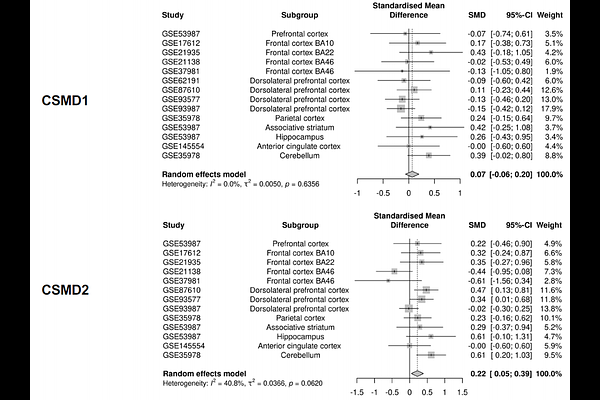
AbstractBackground: Schizophrenia is a neurodevelopmental disorder shaped by immune-related mechanisms, particularly dysregulated complement-mediated synaptic pruning. Genome-wide association studies have identified CSMD1 as a major schizophrenia risk gene, an association robustly replicated across populations of diverse ancestries. As a complement regulator, CSMD1 further links genetic vulnerability to synaptic refinement processes. However, the transcriptional status of CSMD1 and its homolog CSMD2 in individuals with schizophrenia (SZ individuals) remains poorly characterized. We conducted a meta-analysis of gene-expression datasets to determine whether CSMD1 and CSMD2 are differentially expressed in brain and peripheral tissues, and to assess the concordance between central and peripheral transcriptional signals. Methods: Transcriptional data were obtained from gene expression omnibus. Random-effects meta analyses were performed on CSMD1 and CSMD2 expression data from 854 postmortem brain samples derived from 348 SZ individuals and 346 healthy controls (HC), and 295 peripheral blood samples from 162 SZ individuals and 133 HC. Sex-stratified analyses and meta-regressions evaluated potential moderators. Results: In brain tissues, CSMD2 expression was significantly increased in SZ individuals vs. HC (SMD: 0.22 [0.05; 0.39], adj p=0.026), whereas CSMD1 showed no differential expression. The female-only meta analysis revealed nominal CSMD2 overexpression (p=0.037) in brain tissues, not surviving correction. No significant transcriptional differences were detected in peripheral blood. Conclusion: In schizophrenia, our findings point to a dissociation between genetic vulnerability and transcriptional activity within the CSMD gene family. Schizophrenia is associated with selective brain CSMD2 overexpression, contrasting with unchanged CSMD1 transcription and absent peripheral blood alterations. These findings support complement-related dysregulation as a central pathway in schizophrenia.