Ultrastructural remodelling of tau fibrils during ghost tangle formation in Alzheimer's disease brain

Ultrastructural remodelling of tau fibrils during ghost tangle formation in Alzheimer's disease brain
Stähli, D. A.; Travers, L.; Shafiei, N.; van den Heuvel, L.; Vialaneix, E.; Schneider, P. L.; Rozemuller, A. J.; van de Berg, W. D. J.; Stahlberg, H.; Lewis, A. J.
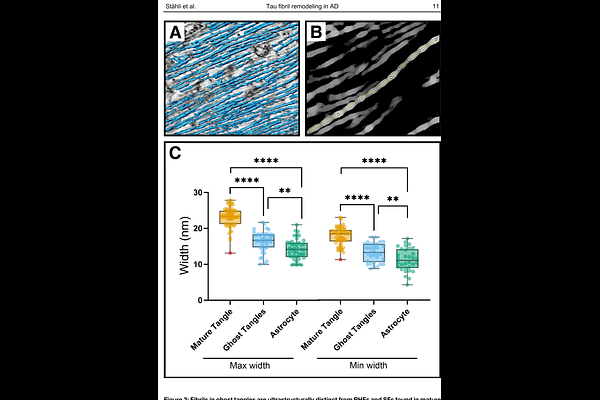
AbstractTau aggregation into intracellular neurofibrillary tangles (NFTs) is one of the major hallmarks of Alzheimer's disease (AD). Based on neuropathological studies, NFTs have been classified into pre-tangles, mature tangles, and ghost tangles, however the ultrastructural transitions between these stages remain poorly understood. Here, we used correlative light and electron microscopy (CLEM) to structurally characterize tau tangle maturity states in post-mortem human AD brain tissue. Pre-tangles showed no consistent fibrillar ultrastructure. Mature tangles contained densely packed, highly aligned paired helical filaments (PHF) and straight filaments (SF), often organized in spatially distinct bundles within the neuronal soma. Ghost tangles lacked cellular organelles and were composed predominantly of thin fibrils compartmentalized by membranous structures, with fibril morphology differing between compartmentalized and non-compartmentalized regions. Electron tomography and fibril segmentation demonstrated that these fibrils were significantly thinner than PHFs and SFs while immunogold labeling using the 2E9 tau marker confirmed the presence of tau within both mature and ghost tangle fibrils. GFAP-positive astrocytic processes infiltrated fibril-rich compartments within ghost tangles, linking astrocytic engagement with the emergence of this distinct ultrastructural organization. Together, our findings show that ghost-tangles contain a structurally distinct population of tau fibrils, suggesting that tau aggregates undergo astrocytic-mediated structural remodeling at late stages of pathology.