Hinode EIS Observations of Plasma Composition Evolution and Radiative Cooling of Solar Flare Loops

Hinode EIS Observations of Plasma Composition Evolution and Radiative Cooling of Solar Flare Loops
Teodora Mihailescu, Peter R. Young, David H. Brooks, Deborah Baker, Lucie M. Green, David M. Long, Lidia van Driel-Gesztelyi
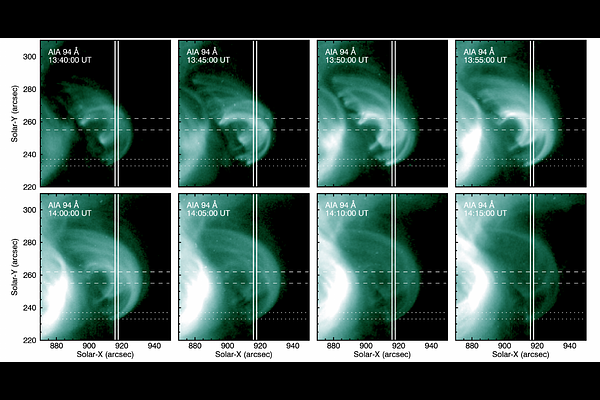
AbstractPlasma composition in flaring regions has been shown to have significant spatial and temporal variations, likely driven by dynamical processes that take place as a consequence of the sudden energy release at the reconnection site. The origins of these variations, as well as the effects they might, in turn, have on flare loops dynamics are not yet fully understood. In this work, we investigate the link between flare loop cooling times and plasma composition evolution in the loops formed during the M-class flare peaking at 13:56 UT on the 2022 April 2 using high cadence Hinode EIS spectroscopic observations. The analysis focuses on quantifying the cooling rate (using a series of emission lines covering a wide temperature range) and plasma composition evolution (using the Ca XIV 193.866 A/Ar XIV 194.401 A diagnostic) at the apex and footpoint of the flare loop arcade. Results show slower cooling and a FIP bias of 2.4 +/- 0.2 in the loop footpoint and faster cooling and a stronger FIP bias of 2.8 +/- 0.2 in the loop apex. The potential effects of plasma composition changes on the radiative cooling process of flare loops are also investigated by comparing observed loop cooling times to those predicted by simulations from the EBTEL 0D hydrodynamic model. The EBTEL simulations show that an higher FIP bias would lead to a faster radiative cooling rate and, therefore, shorter cooling times. This suggests that the variation in FIP bias observed in the two features could be responsible for the different cooling times observed.