Behavioral, hormonal, and chemical responses to seasonality in poison frogs with divergent reproductive strategies

Behavioral, hormonal, and chemical responses to seasonality in poison frogs with divergent reproductive strategies
Serrano-Rojas, S. J.; Pasukonis, A.; Gonzalez, M.; Rodriguez, C.; Calvo Usto, R. F.; Carazas, A.; Sandoval Garcia, C.; Zolorzano, J. P.; Arcila-Perez, L. F.; Boluarte-Salinas, S.; Baldarrago, E.; Sosa-Salazar, A.; O'Connell, L. A.
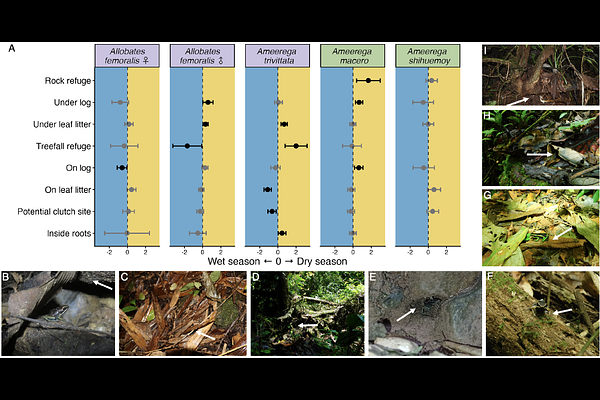
AbstractSeasonal rainfall shapes biological responses in tropical ecosystems, yet how tropical organisms integrate behavioral and physiological responses to cope with seasonality remains poorly understood. We assessed how four poison frog species with contrasting reproductive strategies respond to dry and wet season environmental conditions. We quantified spatial behavior, microhabitat use, hormone concentrations, and chemical defenses in two seasonal breeders (Allobates femoralis and Ameerega trivittata) and two year-round breeders (Ameerega macero and Ameerega shihuemoy). Seasonal breeders exhibited pronounced sex-specific shifts in space use, where males expanded their space use during the wet season, likely to track reproductive opportunities, while A. femoralis females increased their spatial use during the dry season, likely responding to foraging demands when prey resources are sparse. Year-round breeders maintained similar space use across seasons, likely reflecting their ability to access key resources within the same space to reproduce year-round. Microhabitat use was flexible, as seasonal breeders shifted toward humid refugia during the dry season and reproduction-associated microhabitats during the wet season, whereas year-round breeders selected microhabitats that facilitate continuous reproduction across seasons. Despite these behavioral responses, corticosterone, testosterone, and chemical defenses showed no consistent seasonal variation, suggesting that behavioral flexibility is decoupled from seasonal variation in these measured physiological responses. Our study suggests that poison frogs are able to buffer environmental fluctuations through behavioral flexibility. However, given the increasing unpredictability in rainfall timing and intensity as a result of climate change, how these coping strategies will function in the long term is uncertain.