Operational Mass Measurement for Flyby Reconnaissance Missions of Potentially Hazardous Asteroid

Operational Mass Measurement for Flyby Reconnaissance Missions of Potentially Hazardous Asteroid
Justin A. Atchison, Gael Cascioli, Anivid Pedros-Faura, Erwan Mazarico, Rylie A. Bull, Jay McMahon, Evan J. Smith, Daniel R. Cremons
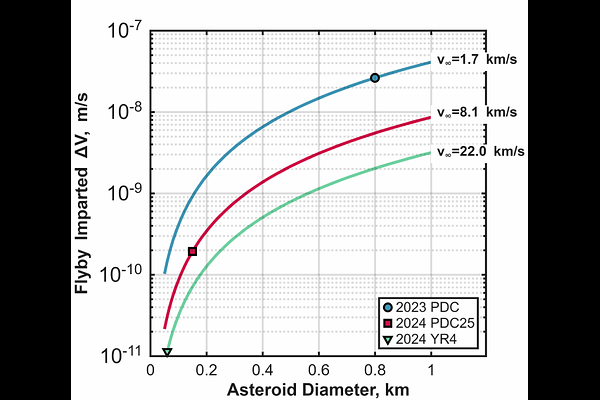
AbstractThis study evaluates a technique for determining the mass of a potentially hazardous asteroid from a high-speed flyby in the context of a rapid reconnaissance planetary defense scenario. We consider a host spacecraft that dispenses a small CubeSat, which acts as a test-mass. Both spacecraft perform approach maneuvers to target their flyby locations, with the host targeting a close proximity flyby and the CubeSat targeting a distant flyby. By incorporating short-range intersatellite measurements between the host and the CubeSat, the mass measurement sensitivity is substantially improved. We evaluate a set of proposed host and CubeSat hardware options against the 2023 and 2025 Planetary Defense Conference hypothetical threats, as well as a hypothetical flyby of 2024 YR4. These scenarios differ predominantly in their flyby speeds, which span from 1.7 to 22 km/s. Based on these scenarios, we demonstrate that a typical radio-frequency intersatellite measurement is ineffective for asteroids with diameters relevant to planetary defense (i.e., 50 - 500 m). However, we find that augmenting the system with a laser-based intersatellite ranging system or a high-precision Doppler system can enable mass measurements of asteroids as small as 100 m across all cases, and as small as 50 m for the slower (< 8 km/s) cases. The results are very sensitive to the timing of the final maneuver, which is used to target the low-altitude flyby point. This presents an operational challenge for the smallest objects, where optical detection times are comparatively late and the optical navigation targeting knowledge converges too slowly.