Spin-up and spin distribution of stellar black holes grown by gas accretion in proto-stellar clusters

Spin-up and spin distribution of stellar black holes grown by gas accretion in proto-stellar clusters
Zacharias Roupas
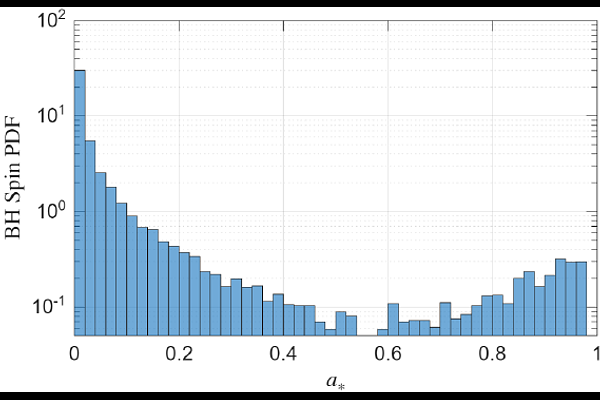
AbstractProto-stellar clusters, likely progenitors of globular clusters, are compact with typical mass $\sim 10^6\,{\rm M}_\odot$ and size $\sim 1\,{\rm pc}$, as revealed recently by JWST observations at $z\sim 10$. Sufficiently high compactness can provide a time window for early-formed stellar black holes (BHs) to accrete primordial gas. We develop a model to determine the final spin distribution of stellar BHs which grow in mass via gas accretion within compact gaseous proto-stellar clusters. The velocity shear within a BH's sphere of influence induces the formation of an accretion disk which is repeatedly disrupted by stochastic perturbations to the BH motion. We assume low initial BH spins $a_{*,{\rm ini}} = 0.01$, and restrict initial BH masses below the upper BH mass gap, $m_{\rm BH,ini} < 55\,{\rm M}_\odot$. Our analysis shows a strong BH spin-mass correlation, obtained within $\sim 10 \,{\rm Myr}$ when gas is depleted. Low-spin BHs, $a_{*} \leq 0.3$, are predominantly low-mass, $m_{\rm BH} \lesssim 25\,{\rm M}_\odot$, in contrast to high-spin black holes, $a_{*} \geq 0.7$, which are predominantly high-mass, $m_{\rm BH} \gtrsim 65\,{\rm M}_\odot$. Notably, there exist also low-spin, high-mass outliers with $\sim 1$ mass-gap BH per cluster expected to have $a_{*} \sim 0.1$. The general trend, however, expressed by the median spin as a function of final BH mass is well fit by a high-spin saturating exponential with transition mass $\sim 50\,{\rm M}_{\odot}$. For $m_{\rm BH} \geq 100\,{\rm M}_\odot$ the median spin is $\bar{a}_{*} \sim 0.90$ with the central $68\%$ of the distribution spanning $a_{*} \sim 0.70 - 0.96$, in striking agreement with the estimated spins of the gravitational-wave signal GW231123. These spin values persist up to the highest masses generated by our mechanism, $m_{\rm BH} \sim 10^3\,{\rm M}_\odot$.