Northward expansion of Rugulopteryx okamurae (Dictyotales, Ochrophyta) in the southeastern Iberian Peninsula: first record in Calpe (Comunitat Valenciana)

Northward expansion of Rugulopteryx okamurae (Dictyotales, Ochrophyta) in the southeastern Iberian Peninsula: first record in Calpe (Comunitat Valenciana)
RODRIGUEZ-GARCIA, E.; FERNANDEZ DEL CAMPO, J.; DOBSON, J. Y.; FONFRIA, E. S.; BORDEHORE, C.; PENA-MARTIN, C.
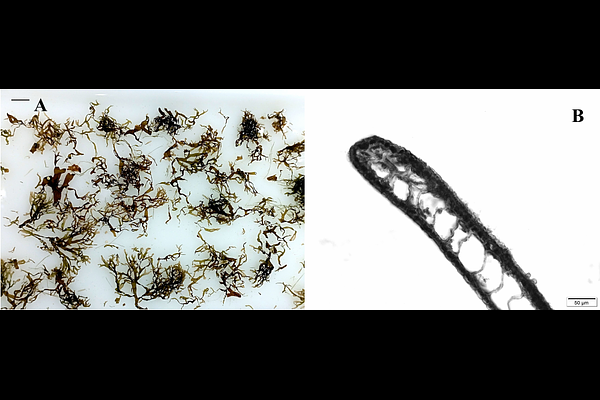
AbstractThe non-indigenous brown macroalga Rugulopteryx okamurae has emerged as one of the most aggressive marine invaders in European waters, deeply altering benthic communities and causing severe socioeconomic impacts. While its expansion has been extensively documented along the southern Iberian Peninsula, understanding the dynamics of its northward range expansion along the Spanish Mediterranean coast remains critical for coastal management. This study documents the first formal record of R. okamurae in Calpe (Alicante), representing its current northernmost distribution limit within the Comunitat Valenciana. Sampling was conducted through an initial opportunistic scuba diving observation along the surrounding waters of the Penyal d'Ifac Natural Park, followed by targeted underwater surveys and an ad hoc inspection of commercial bottom-trawling nets drying at the port of Calpe during June 2026. Morphological and anatomical identification was confirmed through cross-sections of the thallus under optical microscopy, revealing the presence of both the thick and intermediate morphotypes of the species. The collected specimens were found either entangled within a native photophilic algal canopy in shallow waters or recovered from deeper offshore fishing grounds. Given the absence of records in the area during 2023-2025 surveys, these findings suggest either a very recent front-wave colonization event or a contribution from nearby, yet undetected, established patches, driven by secondary local dispersal mechanisms such as drifting fragments and explicitly highlighting commercial fishing activities as an active vector. Furthermore, considering that the species was recorded within a marine protected area and deeper environments, these results highlight a potential ecological threat to local benthic ecosystems, emphasizing the urgent need for competent authorities to implement spatiotemporal monitoring and public awareness campaigns to prevent the definitive establishment of this invader.