Mamba Flow Matching Neural Processes: Linear-Time Inference for Irregularly Observed Spatial Fields

Mamba Flow Matching Neural Processes: Linear-Time Inference for Irregularly Observed Spatial Fields
Cosmo Santoni, Giovanni Charles, Timothy James Hitge, Oliver Watson, Elizaveta Semenova
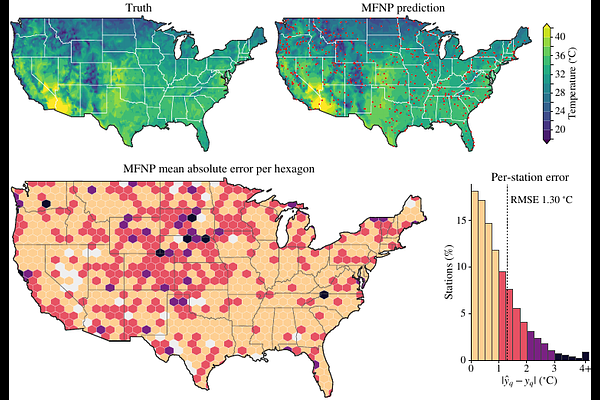
AbstractInterpolating a spatial field, such as daily maximum temperature, from sparse, irregularly located observations recurs across the environmental and health sciences. Standard Gaussian-process kriging refits hyperparameters and solves an $O(N^3)$ system for every new field. When many related fields are observed, such as daily maps from one sensor network, neural processes (NPs) instead learn the interpolation map from past fields and predict a new field in one forward pass. Joint-predictive variants, which sample whole fields rather than independent per-location values, typically use self-attention over context and query points, costing $O(K^2)$ in the combined point count $K$ and limiting practical use to a few thousand points. State-space models offer a linear-time alternative, but a direct state-space adaptation compresses the context into one hidden state before reading queries, reducing what the decoder sees. We propose MambaFlowNP, a linear-compute joint-predictive NP trained with conditional flow matching. A multi-directional Mamba-2 scan reads context and query tokens in one shared sequence, so each query's velocity is read from its own scan position rather than a compressed context summary, and because queries only read the scan state, predictions are consistent across query sets. MambaFlowNP is competitive with the strongest attention-based joint-predictive baselines on synthetic Matérn Gaussian-process benchmarks, and on regional to continental-scale NOAA temperature interpolation it attains the lowest RMSE and CRPS and near-nominal coverage on every tier, while running 114--784$\times$ faster than the strongest joint-predictive baseline. A single forward pass scales to $10^6$ points on one NVIDIA L40S GPU in under a second. This makes joint prediction feasible for continental-scale, irregularly sampled sensor networks; predictive quality is evaluated up to $K=5{,}580$.