Life, the universe, and everything for $42: ultra-low pass sequencing of maize for genotyping, mapping, and pedigree analysis

Life, the universe, and everything for $42: ultra-low pass sequencing of maize for genotyping, mapping, and pedigree analysis
Khangura, R. S.; Kaur, A.; San Miguel, P. J.; Dilkes, B. P.
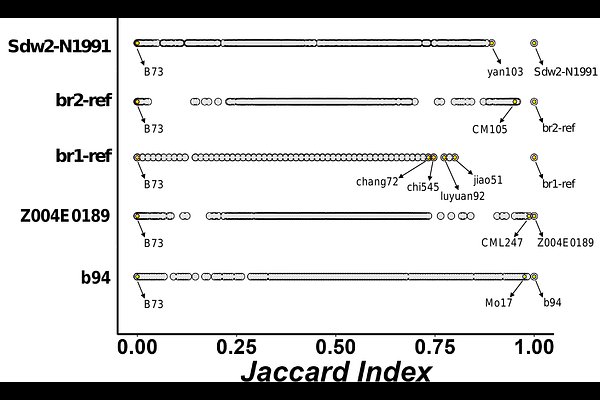
AbstractConvenient and economical genotyping methods and simplified bioinformatic workflows are critical for genetic studies and breeding. The declining cost of sequencing library construction, sample multiplexing, and the advent of skim sequencing has reduced costs and enabled large-scale genetic and genomic experiments. Here, we present a simple skim sequencing and bioinformatics pipeline sufficient for various genotyping applications. Our low-depth skim sequencing method costs 21 USD per sample and provides an average of 144k reads. Our approach uses a double-stranded DNA sample to prepare libraries for genome sequencing. We demonstrate various uses for this strategy in maize, a complex and large (2.5 Gbp) genome. DNA from multiple pedigreed populations, including advanced backcrossed progenies, bi-parental populations, near-isogenic lines, and recombinant inbred lines, were used to map loci, detect donor introgressions, and determine introgression haplotypes. Read counts at known polymorphic positions detected donor genotypes even when derived from parents of unknown origin and could localize mutations of phenotypic impact via bulked segregant analysis. Remarkably, the small amount of sequencing data produced were sufficient to identify the haplotypes of introgressions of unknown origin from by comparison to known genotypes. Correct haplotype identification enabled more accurate allele frequencies to be calculated when mapping loci. This is of exceptional value in maize, where a rich collection of mutants from the 20th century are of unknown pedigree.