A Donor T-Cell Receptor Structural Signature Determines Alloreactive Potential and Predicts Acute Graft-Versus-Host Disease

A Donor T-Cell Receptor Structural Signature Determines Alloreactive Potential and Predicts Acute Graft-Versus-Host Disease
Wang, X. K.; Uzuni, A.; Shi, L.; Harle, D. W.; Macedo, R. J.; Pressler, M.; Gordillo, C. A.; Belay, K.; Chakrabarti, S.; Fuller, J.; Hexner, E. O.; Loren, A. W.; Porter, D. L.; Mapara, M. Y.; Sykes, M.; Azizi, E.; Reshef, R.
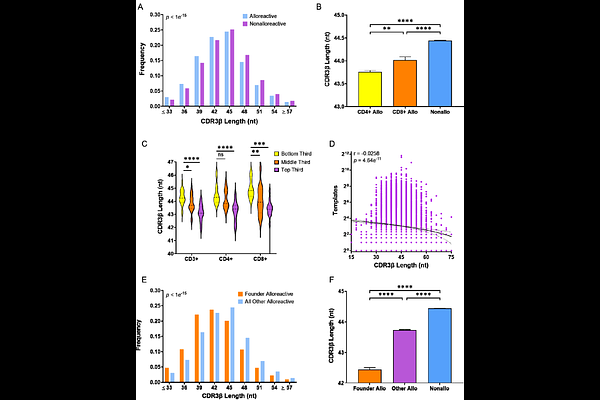
AbstractAcute graft-versus-host disease (GVHD) remains a lethal barrier to successful allogeneic hematopoietic cell transplantation, yet pre-transplant donor selection entirely ignores hypervariable T-cell receptor (TCR) architecture. Here, by characterizing over 64,000 alloreactive clonotypes, we demonstrate that human alloreactivity is dictated by a constrained, predictable baseline structural signature. Pathogenic, tissue-infiltrating alloreactive T cells exhibit significantly shortened CDR3{beta} regions, altered antigen-facing biophysical features, biased VJ gene usage and extensive inter-donor sharing originating from public anti-pathogen memory reservoirs. These potent clones natively cluster within the high-frequency fraction of the unstimulated baseline donor repertoire. We introduce R50, an assay-independent metric quantifying this clonal dominance, which independently predicted a six-fold increased risk of acute GVHD in a cross-institutional cohort. This scalable in silico platform shifts pre-transplant risk stratification from HLA typing and demographic surrogates to precision immune-receptor modeling.