Distinct contribution of autoreactive B cell Bruton's tyrosine kinase signaling to neuroinflammation

Distinct contribution of autoreactive B cell Bruton's tyrosine kinase signaling to neuroinflammation
Ogbaslase, A. T.; Archambault, A. S.; Barclay, K. M.; Ridore, B. E.; Amosu, J.; Ying, K.; Bandla, S.; Sturtz, A. J.; Li, Q.; Kendall, P. L.; Wu, G. F.
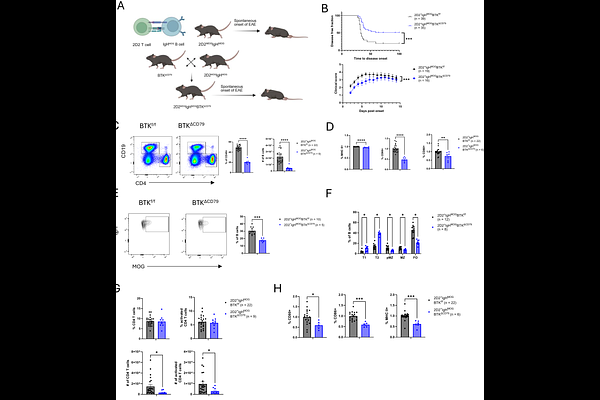
AbstractIn multiple sclerosis (MS), autoreactive B cells play a central role in driving CD4 T cell-mediated inflammatory damage to myelin (1). Here we investigated how disrupting Bruton's tyrosine kinase (BTK) signaling exclusively in B cells shapes the course of experimental autoimmune encephalomyelitis (EAE), a model for MS, through alterations in B cell development and activity. B cell-specific BTK deletion significantly ameliorated both human MOG (hMOG) induced EAE (p = 0.0087) as well as spontaneous disease in 2D2+IgHMOG mice (p = 0.0004). Additionally, MOG-specific cells were found to be more sensitive to loss of BTK than tolerant clones (p = 0.0002) and production of anti-MOG immunoglobulins was also found to be diminished (p < 0.004) while overall IgG was unchanged (p = 0.44). B cells isolated from conditional knockout mice did not upregulate expression of co-stimulatory receptors or MHC II to the same extent as controls when cultured alongside MOG-specific CD4 T cells (p < 0.005) and were inferior at driving T cell proliferation (p < 0.0001) in vitro. Lastly, while BTK deletion diminished the proliferative and survival response of B cells following mitogen stimulation, B cell trafficking to the leptomeninges and organization into ectopic lymphoid tissues (ELTs) in 2D2+IgHMOG mice continued unabated. We identified that BTK signaling regulates several features adopted by autoreactive B cells that contribute to EAE pathogenesis. This study provides mechanistic insights into the therapeutic benefits of BTK inhibitors observed in clinical trials exploring BTK as a therapeutic target in the context of MS.